SOLDES
Jusqu'à -70% sur une sélection d'articles*

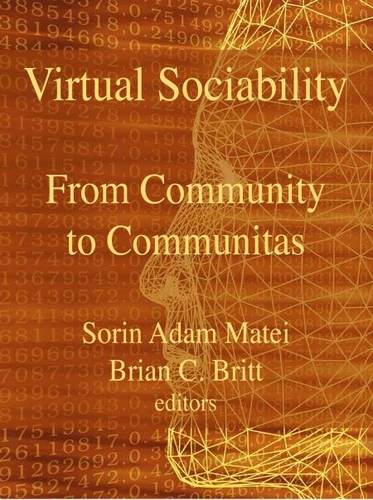
Virtual Sociability: From Community To Communitas
Par :Formats :
Disponible dans votre compte client Decitre ou Furet du Nord dès validation de votre commande. Le format ePub est :
- Compatible avec une lecture sur My Vivlio (smartphone, tablette, ordinateur)
- Compatible avec une lecture sur liseuses Vivlio
- Pour les liseuses autres que Vivlio, vous devez utiliser le logiciel Adobe Digital Edition. Non compatible avec la lecture sur les liseuses Kindle, Remarkable et Sony
 , qui est-ce ?
Notre partenaire de plateforme de lecture numérique où vous retrouverez l'ensemble de vos ebooks gratuitement
Pour en savoir plus sur nos ebooks, consultez notre aide en ligne ici
C'est si simple ! Lisez votre ebook avec l'app Vivlio sur votre tablette, mobile ou ordinateur :

- FormatePub
- ISBN978-1-4660-9594-6
- EAN9781466095946
- Date de parution08/05/2011
- Protection num.pas de protection
- Infos supplémentairesepub
- ÉditeurWild Bohr Press
Résumé
To what degree can the human exchanges we observe online be called "sociability"? In other words, do these exchanges amount to any meaningful type of social organization? Are they more than the mere froth of collective emotion discharging its energy with a lot of noise but little consequence against the wave breakers of social media? Do the social interactions that take place in virtual space-all those kind or not-so-kind words sent back and forth-suggest the same level of commitment, dedication, morality, passion, or even depravity that we see in everyday life? Or, more succinctly, is sociability online less "social, " less "real" than what we see in everyday life?The present collection of papers reflects some of the most insightful contributions to the Purdue Online Interaction Seminar.
Representing a variety of interpretive frameworks, the conversation is circumscribed by a number of themes, of which two are most important. The first one is the nature of online sociability. Are or could online groups be "community-like, " bound by ties as strong as those of kith and kin? Should they be qualified as a type of contractual, rational, self-interested "society"? Or should we propose a new interpretive framework? Should online communities be seen as a type of "communitas", which is a form of social aggregation that appears during certain initiation rituals? If this is so, are communitas-like virtual spaces characterized by the same transient, liminal state that mixes a variety of contradictory characteristics (temporary and permanent, close and distant, essential and fleeting) that we observe in other types of "communitas"? Can virtual communitas lead to social and personal transformation, just like its traditional counterpart?Table of ContentsSorin Adam MateiIntroductionThe book is dead! Long live the ubibook!User GuideSusan Huelsing SarapinFront Porches and Public Spaces: Planned Communities OnlinePamela MorrisGlimpses of Community on the WebBrenda Berkelaar Van PeltPeering Behind the Curtain: The Virtual Wizard Offers No GuaranteesBrian C.
BrittThe Invisible Man: Speaking into the Online VoidRobert N. YaleWelcome to I-berspace: Media Gratifications in Successful Virtual CommunitiesChristina KalinowskiIndividualism Online: Virtually Escaping the 'Massness' or Vanishing into the 'Electrovoid'?W. Scott SandersSIDE Theory, Small World Networks, and Smart Mob Formation: A Beginner's GuideOnline Interaction Seminar: Selected Readings and Discussion TopicsAuthor Biographies
Representing a variety of interpretive frameworks, the conversation is circumscribed by a number of themes, of which two are most important. The first one is the nature of online sociability. Are or could online groups be "community-like, " bound by ties as strong as those of kith and kin? Should they be qualified as a type of contractual, rational, self-interested "society"? Or should we propose a new interpretive framework? Should online communities be seen as a type of "communitas", which is a form of social aggregation that appears during certain initiation rituals? If this is so, are communitas-like virtual spaces characterized by the same transient, liminal state that mixes a variety of contradictory characteristics (temporary and permanent, close and distant, essential and fleeting) that we observe in other types of "communitas"? Can virtual communitas lead to social and personal transformation, just like its traditional counterpart?Table of ContentsSorin Adam MateiIntroductionThe book is dead! Long live the ubibook!User GuideSusan Huelsing SarapinFront Porches and Public Spaces: Planned Communities OnlinePamela MorrisGlimpses of Community on the WebBrenda Berkelaar Van PeltPeering Behind the Curtain: The Virtual Wizard Offers No GuaranteesBrian C.
BrittThe Invisible Man: Speaking into the Online VoidRobert N. YaleWelcome to I-berspace: Media Gratifications in Successful Virtual CommunitiesChristina KalinowskiIndividualism Online: Virtually Escaping the 'Massness' or Vanishing into the 'Electrovoid'?W. Scott SandersSIDE Theory, Small World Networks, and Smart Mob Formation: A Beginner's GuideOnline Interaction Seminar: Selected Readings and Discussion TopicsAuthor Biographies