Nouveauté
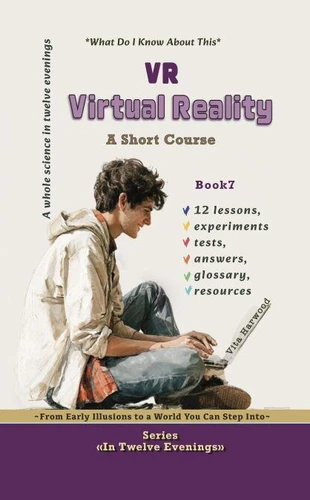
Virtual Reality: What Do I Already Know About This. In Twelve Evenings, #7
Par :Formats :
Disponible dans votre compte client Decitre ou Furet du Nord dès validation de votre commande. Le format ePub protégé est :
- Compatible avec une lecture sur My Vivlio (smartphone, tablette, ordinateur)
- Compatible avec une lecture sur liseuses Vivlio
- Pour les liseuses autres que Vivlio, vous devez utiliser le logiciel Adobe Digital Edition. Non compatible avec la lecture sur les liseuses Kindle, Remarkable et Sony
- Non compatible avec un achat hors France métropolitaine
 , qui est-ce ?
Notre partenaire de plateforme de lecture numérique où vous retrouverez l'ensemble de vos ebooks gratuitement
Pour en savoir plus sur nos ebooks, consultez notre aide en ligne ici
C'est si simple ! Lisez votre ebook avec l'app Vivlio sur votre tablette, mobile ou ordinateur :

- FormatePub
- ISBN8235445420
- EAN9798235445420
- Date de parution29/08/2026
- Protection num.Adobe DRM
- Infos supplémentairesepub
- ÉditeurIoakim Ioakim
Résumé
Virtual Reality: What Do I Already Know About This? From Early Illusions to a World You Can Step IntoSeries "In Twelve Evenings" BOOK 7 Vita HarwoodTest your knowledge!What does it take to make the brain accept a world that is not really there? Why can two small displays become a vast space, why can a virtual drop trigger a real physical reaction, and why can a digital body begin to feel surprisingly close to your own?Virtual Reality: From Early Illusions to a World You Can Step Into explores those questions across twelve evenings of history, engineering, perception, and real-world use.
The book begins with the central puzzle of presence: how can you know you are standing in a room and still react to a digital environment as if it surrounds you? From there, it explains stereoscopic vision, head and hand tracking, spatial audio, latency, rendering, interaction design, avatars, embodiment, and haptic feedback in clear language without flattening the science. VR in this course is much bigger than headsets and games.
Separate lessons examine medical and training simulations, therapy, education, design, skill practice, privacy, behavioral data, and the ethical questions that appear when immersive systems can measure how we move and where we look. The book distinguishes what is already useful, what is still being tested, and what remains a promise about the future. Every lesson is structured as an investigation and ends with key terms, a ten-question test, and a small home experiment.
A course-long project, My Virtual World, lets readers build the concept for their own VR experience step by step, with no programming required. In twelve evenings, you will travel from stereoscopes and early machines of illusion to spatial computing, biometric data, and one increasingly important question: what changes if virtual environments become as ordinary as screens are today?
The book begins with the central puzzle of presence: how can you know you are standing in a room and still react to a digital environment as if it surrounds you? From there, it explains stereoscopic vision, head and hand tracking, spatial audio, latency, rendering, interaction design, avatars, embodiment, and haptic feedback in clear language without flattening the science. VR in this course is much bigger than headsets and games.
Separate lessons examine medical and training simulations, therapy, education, design, skill practice, privacy, behavioral data, and the ethical questions that appear when immersive systems can measure how we move and where we look. The book distinguishes what is already useful, what is still being tested, and what remains a promise about the future. Every lesson is structured as an investigation and ends with key terms, a ten-question test, and a small home experiment.
A course-long project, My Virtual World, lets readers build the concept for their own VR experience step by step, with no programming required. In twelve evenings, you will travel from stereoscopes and early machines of illusion to spatial computing, biometric data, and one increasingly important question: what changes if virtual environments become as ordinary as screens are today?