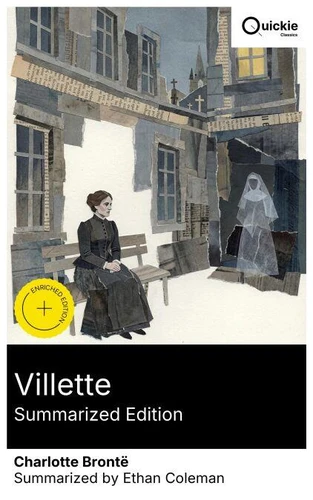
Set in the francophone capital of Labassecour, Villette follows the reticent Englishwoman Lucy Snowe as she finds precarious employment at Madame Beck's pensionnat, negotiates surveillance and secrecy, and develops fraught attachments to Dr. John and the exacting M. Paul Emanuel. Brontë's taut first-person voice withholds as much as it reveals, interweaving Gothic apparitions-the spectral nun-with granular social realism and polyglot dialogue.
Published in 1853 after the upheavals of 1848, the novel probes female solitude, religious difference, and the costs of self-command within mid-Victorian culture. Charlotte Brontë drew intensely on her Belgian sojourn (1842-43), her work as a governess, and the desolations following the deaths of her siblings to shape Lucy's austerity and exile. Having earlier masked herself as Currer Bell and reworked Brussels material in The Professor, she turns here to a more mature, psychologically inward design, inflecting personal correspondence with Constantin Heger into the figure of M.
Paul and the novel's contested ethics of attachment. Readers seeking rigorous psychological depth, sly irony, and an unsentimental portrait of a woman's interior life will find Villette inexhaustible. Best approached with patience for untranslated French and narrative gaps, it rewards close reading with a daring, ambiguous finale and a modern sensibility.
Quickie Classics summarizes timeless works with precision, preserving the author's voice and keeping the prose clear, fast, and readable-distilled, never diluted.
Enriched Edition extras: Introduction · Synopsis · Historical Context · Author Biography · Brief Analysis · 4 Reflection Q&As · Editorial Footnotes.
Set in the francophone capital of Labassecour, Villette follows the reticent Englishwoman Lucy Snowe as she finds precarious employment at Madame Beck's pensionnat, negotiates surveillance and secrecy, and develops fraught attachments to Dr. John and the exacting M. Paul Emanuel. Brontë's taut first-person voice withholds as much as it reveals, interweaving Gothic apparitions-the spectral nun-with granular social realism and polyglot dialogue.
Published in 1853 after the upheavals of 1848, the novel probes female solitude, religious difference, and the costs of self-command within mid-Victorian culture. Charlotte Brontë drew intensely on her Belgian sojourn (1842-43), her work as a governess, and the desolations following the deaths of her siblings to shape Lucy's austerity and exile. Having earlier masked herself as Currer Bell and reworked Brussels material in The Professor, she turns here to a more mature, psychologically inward design, inflecting personal correspondence with Constantin Heger into the figure of M.
Paul and the novel's contested ethics of attachment. Readers seeking rigorous psychological depth, sly irony, and an unsentimental portrait of a woman's interior life will find Villette inexhaustible. Best approached with patience for untranslated French and narrative gaps, it rewards close reading with a daring, ambiguous finale and a modern sensibility.
Quickie Classics summarizes timeless works with precision, preserving the author's voice and keeping the prose clear, fast, and readable-distilled, never diluted.
Enriched Edition extras: Introduction · Synopsis · Historical Context · Author Biography · Brief Analysis · 4 Reflection Q&As · Editorial Footnotes.

 , qui est-ce ?