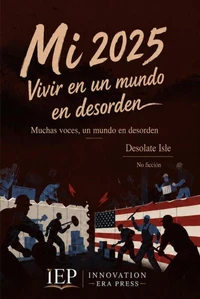
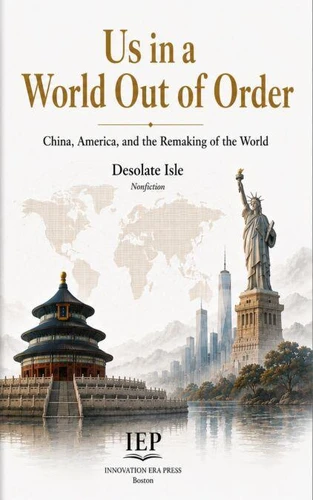
Us in a World Out of Order: China, America, and the Remaking of the World is a work of long-form nonfiction that is at once a cool-eyed reckoning with political economy and the solitary memoir of one man. Writing in the first person, Desolate Isle records the year 2025-outwardly calm, inwardly convulsing-and the violent unraveling of the old global order that followed into 2026. He begins in a dim eight-square-meter room in Los Angeles and moves outward through asylum interviews, detention, interrogation, and the machinery of a state closing in.
Once a transportation expert, entrepreneur, and inventor who had worked within the Chinese state system and knew its workings from the inside, he watched his assets fall to nothing-and drove, alone, through the small hours of foreign nights, 1, 495 fares in all, to hold off the dusk gathering in his soul. Across fifteen countries and regions-the United States, China, Southeast Asia, Canada, Japan-he talks, unflinchingly, with some seventy people: undocumented migrants, laborers at the bottom, entrepreneurs working across borders, scholars, a Vietnam War veteran, government officials.
With the trained eye of a sociologist and an engineer, he strips the grand narrative of its political dress and turns what he finds-the collusion of the courts and police, the squeeze of state monopoly on private enterprise, the vast fiscal cost hidden behind big-data control-into vivid, unsparing slices of a real society. This book does not argue abstractions. It begins with the particular human being, trapped in a society of appetite, and by that light makes the structural upheaval of the world visible to more of us.
It is a book for the general reader about lives and livelihoods, and a window onto the social and economic reality of China and America, and onto the societies of North America, Southeast Asia, and Japan.
Us in a World Out of Order: China, America, and the Remaking of the World is a work of long-form nonfiction that is at once a cool-eyed reckoning with political economy and the solitary memoir of one man. Writing in the first person, Desolate Isle records the year 2025-outwardly calm, inwardly convulsing-and the violent unraveling of the old global order that followed into 2026. He begins in a dim eight-square-meter room in Los Angeles and moves outward through asylum interviews, detention, interrogation, and the machinery of a state closing in.
Once a transportation expert, entrepreneur, and inventor who had worked within the Chinese state system and knew its workings from the inside, he watched his assets fall to nothing-and drove, alone, through the small hours of foreign nights, 1, 495 fares in all, to hold off the dusk gathering in his soul. Across fifteen countries and regions-the United States, China, Southeast Asia, Canada, Japan-he talks, unflinchingly, with some seventy people: undocumented migrants, laborers at the bottom, entrepreneurs working across borders, scholars, a Vietnam War veteran, government officials.
With the trained eye of a sociologist and an engineer, he strips the grand narrative of its political dress and turns what he finds-the collusion of the courts and police, the squeeze of state monopoly on private enterprise, the vast fiscal cost hidden behind big-data control-into vivid, unsparing slices of a real society. This book does not argue abstractions. It begins with the particular human being, trapped in a society of appetite, and by that light makes the structural upheaval of the world visible to more of us.
It is a book for the general reader about lives and livelihoods, and a window onto the social and economic reality of China and America, and onto the societies of North America, Southeast Asia, and Japan.

 , qui est-ce ?