SOLDES
Jusqu'à -70% sur une sélection d'articles*

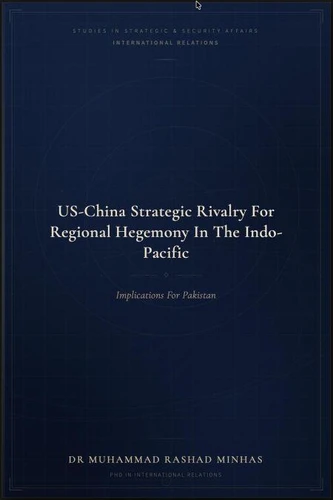
US-China Strategic Rivalry for Regional Hegemony in the Indo-Pacific: Implications for Pakistan
Par :Formats :
Disponible dans votre compte client Decitre ou Furet du Nord dès validation de votre commande. Le format ePub est :
- Compatible avec une lecture sur My Vivlio (smartphone, tablette, ordinateur)
- Compatible avec une lecture sur liseuses Vivlio
- Pour les liseuses autres que Vivlio, vous devez utiliser le logiciel Adobe Digital Edition. Non compatible avec la lecture sur les liseuses Kindle, Remarkable et Sony
 , qui est-ce ?
Notre partenaire de plateforme de lecture numérique où vous retrouverez l'ensemble de vos ebooks gratuitement
Pour en savoir plus sur nos ebooks, consultez notre aide en ligne ici
C'est si simple ! Lisez votre ebook avec l'app Vivlio sur votre tablette, mobile ou ordinateur :

- FormatePub
- ISBN8233707414
- EAN9798233707414
- Date de parution20/03/2026
- Protection num.pas de protection
- Infos supplémentairesepub
- ÉditeurLinda Balsamo
Résumé
Book DescriptionUS-China Strategic Rivalry for Regional Hegemony in the Indo-Pacific: Implications for PakistanBy Dr Muhammad Rashad MinhasThe twenty-first century's most consequential geopolitical contest is unfolding across the vast waters and contested territories of the Indo-Pacific. As the United States strives to preserve its post-Cold War hegemonic order and China rises with historic velocity - armed with economic ambition, military modernisation, and a vision of multipolarity - the world stands at an inflection point.
At the heart of this great power struggle lies a question of immense consequence for smaller and middle-power states: How do nations caught between titans protect their sovereignty, advance their interests, and ensure their survival?This book offers a rigorous, deeply researched examination of the US-China strategic rivalry through the prism of two foundational theories of international relations - Realism and Complex Interdependence.
Drawing upon extensive primary research, including sixteen in-depth field interviews with senior diplomats, defence strategists, policymakers, and leading academics from Pakistan, China, and the United States, the work moves beyond abstract theorising to ground its analysis in the voices and perspectives of those who shape and are shaped by this rivalry. The result is a study that is at once scholarly in its methodology and urgent in its relevance.
Beginning with the historical evolution of the Indo-Pacific as a geopolitical construct - from Karl Haushofer's early twentieth-century formulations to Shinzo Abe's landmark "Confluence of the Two Seas" address - the book traces how the region ascended from a peripheral geographic concept to the defining theatre of great power competition. It examines the strategic architecture of the US response, from Obama's "Pivot to Asia" to Trump's "Free and Open Indo-Pacific" doctrine and Biden's Indo-Pacific Strategy, alongside China's counterbalancing manoeuvres through the Belt and Road Initiative, military modernisation, and the construction of a maritime "String of Pearls" across the Indian Ocean.
At the centre of this analysis stands Pakistan - a nuclear-armed state situated at the crossroads of South Asia, Central Asia, and the Middle East. The book argues that Pakistan occupies a uniquely vulnerable yet strategically significant position in the evolving Indo-Pacific order. As the flagship corridor of China's Belt and Road Initiative, the China-Pakistan Economic Corridor (CPEC) has deepened Pakistan's strategic alignment with Beijing, yet Islamabad's historical security and defence ties with Washington, its enduring rivalry with India, and its fragile economic foundations demand a far more nuanced and adaptive foreign policy than simple alignment with either power.
The book provides a comprehensive assessment of the strategic, security, economic, diplomatic, and maritime implications of the US-China rivalry for Pakistan, offering concrete policy recommendations for navigating this perilous landscape. This work is essential reading for scholars of international relations, strategic studies, and South Asian affairs; for policymakers and diplomats seeking to understand the forces reshaping global order; and for any reader who recognises that the contest for the Indo-Pacific will define the trajectory of the twenty-first century - and that the choices made by nations like Pakistan will determine whether this new era is marked by cooperation or conflict.
At the heart of this great power struggle lies a question of immense consequence for smaller and middle-power states: How do nations caught between titans protect their sovereignty, advance their interests, and ensure their survival?This book offers a rigorous, deeply researched examination of the US-China strategic rivalry through the prism of two foundational theories of international relations - Realism and Complex Interdependence.
Drawing upon extensive primary research, including sixteen in-depth field interviews with senior diplomats, defence strategists, policymakers, and leading academics from Pakistan, China, and the United States, the work moves beyond abstract theorising to ground its analysis in the voices and perspectives of those who shape and are shaped by this rivalry. The result is a study that is at once scholarly in its methodology and urgent in its relevance.
Beginning with the historical evolution of the Indo-Pacific as a geopolitical construct - from Karl Haushofer's early twentieth-century formulations to Shinzo Abe's landmark "Confluence of the Two Seas" address - the book traces how the region ascended from a peripheral geographic concept to the defining theatre of great power competition. It examines the strategic architecture of the US response, from Obama's "Pivot to Asia" to Trump's "Free and Open Indo-Pacific" doctrine and Biden's Indo-Pacific Strategy, alongside China's counterbalancing manoeuvres through the Belt and Road Initiative, military modernisation, and the construction of a maritime "String of Pearls" across the Indian Ocean.
At the centre of this analysis stands Pakistan - a nuclear-armed state situated at the crossroads of South Asia, Central Asia, and the Middle East. The book argues that Pakistan occupies a uniquely vulnerable yet strategically significant position in the evolving Indo-Pacific order. As the flagship corridor of China's Belt and Road Initiative, the China-Pakistan Economic Corridor (CPEC) has deepened Pakistan's strategic alignment with Beijing, yet Islamabad's historical security and defence ties with Washington, its enduring rivalry with India, and its fragile economic foundations demand a far more nuanced and adaptive foreign policy than simple alignment with either power.
The book provides a comprehensive assessment of the strategic, security, economic, diplomatic, and maritime implications of the US-China rivalry for Pakistan, offering concrete policy recommendations for navigating this perilous landscape. This work is essential reading for scholars of international relations, strategic studies, and South Asian affairs; for policymakers and diplomats seeking to understand the forces reshaping global order; and for any reader who recognises that the contest for the Indo-Pacific will define the trajectory of the twenty-first century - and that the choices made by nations like Pakistan will determine whether this new era is marked by cooperation or conflict.