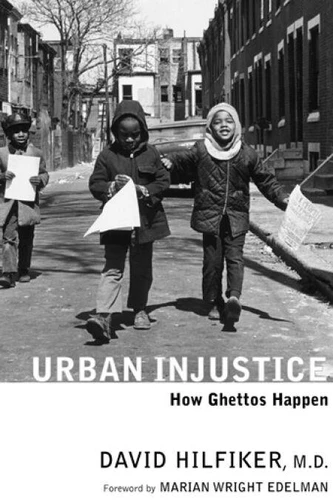
David Hilfiker has committed his life, both as a writer and a doctor, to people in need, writing about the urban poor with whom he's spent all his days for the last two decades. In Urban Injustice, he explains in beautiful and simple language how the myth that the urban poor siphon off precious government resources is contradicted by the facts, and how most programs help some of the people some of the time but are almost never sufficiently orchestrated to enable people to escape the cycle of urban poverty.
Hilfiker is able to present a surprising history of poverty programs since the New Deal, and shows that many of the biggest programs were extremely successful at attaining the goals set out for them. Even so, Hilfiker reveals, most of the best and biggest programs were "social insurance" programs, like Medicare and Social Security, that primarily assisted the middle class, not the poor. Whereas, "public assistance" programs, directed specifically towards the poor, were often extremely effective as far as they went, but were instituted with far less ambitious goals.
In a book that is short, sweet, and completely without academic verboseness or pretension, Hilfiker makes a clear path through the complex history of societal poverty, the obvious weaknesses and surprising strengths of societal responses to poverty thus far, and offers an analysis of models of assistance from around the world that might perhaps assist us in making a better world for our children once we decide that is what we must do.
David Hilfiker has committed his life, both as a writer and a doctor, to people in need, writing about the urban poor with whom he's spent all his days for the last two decades. In Urban Injustice, he explains in beautiful and simple language how the myth that the urban poor siphon off precious government resources is contradicted by the facts, and how most programs help some of the people some of the time but are almost never sufficiently orchestrated to enable people to escape the cycle of urban poverty.
Hilfiker is able to present a surprising history of poverty programs since the New Deal, and shows that many of the biggest programs were extremely successful at attaining the goals set out for them. Even so, Hilfiker reveals, most of the best and biggest programs were "social insurance" programs, like Medicare and Social Security, that primarily assisted the middle class, not the poor. Whereas, "public assistance" programs, directed specifically towards the poor, were often extremely effective as far as they went, but were instituted with far less ambitious goals.
In a book that is short, sweet, and completely without academic verboseness or pretension, Hilfiker makes a clear path through the complex history of societal poverty, the obvious weaknesses and surprising strengths of societal responses to poverty thus far, and offers an analysis of models of assistance from around the world that might perhaps assist us in making a better world for our children once we decide that is what we must do.

 , qui est-ce ?
