
Tine Trumpp studied Geography at Heidelberg University and Uppsala University, Sweden. Since 2013 she has been working as a research associate and lecturer at the Institute of Geography at Cologne University. Her main research is on urbanization, urban governance, and urban heritage, with a specific regional focus on India.
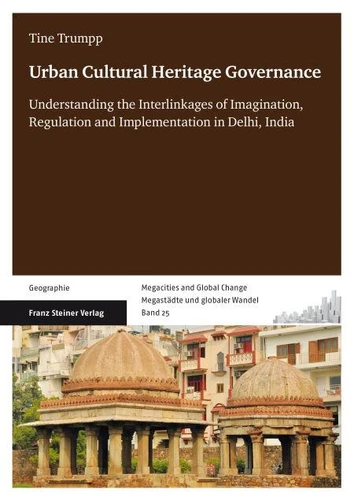
Urban Cultural Heritage Governance. Understanding the Interlinkages of Imagination, Regulation and Implementation in Delhi, India
Par :Formats :
Disponible dans votre compte client Decitre ou Furet du Nord dès validation de votre commande. Le format PDF est :
- Compatible avec une lecture sur My Vivlio (smartphone, tablette, ordinateur)
- Compatible avec une lecture sur liseuses Vivlio
- Pour les liseuses autres que Vivlio, vous devez utiliser le logiciel Adobe Digital Edition. Non compatible avec la lecture sur les liseuses Kindle, Remarkable et Sony
 , qui est-ce ?
Notre partenaire de plateforme de lecture numérique où vous retrouverez l'ensemble de vos ebooks gratuitement
Pour en savoir plus sur nos ebooks, consultez notre aide en ligne ici
C'est si simple ! Lisez votre ebook avec l'app Vivlio sur votre tablette, mobile ou ordinateur :

- Nombre de pages217
- FormatPDF
- ISBN978-3-515-12347-1
- EAN9783515123471
- Date de parution18/07/2019
- Protection num.Digital Watermarking
- Taille4 Mo
- Infos supplémentairespdf
- ÉditeurFranz Steiner
Résumé
As a result of current urbanization dynamics the cultural heritage of Indian cities is under enormous pressure and threatened by decay. At the same time it makes a central contribution to social and societal identity of these cities and has a major influence both economically and aesthetically on the competitiveness of cities in international and national contexts.
The responsibility for safeguarding urban cultural heritage, however, does not lie with public authorities only, but is embedded in the complex structures of public and private, individual and collective stakeholders acting at different levels with their respective interests.
This study shows that social and professional discourses on urban cultural heritage and its protection highly influence conservation efforts.
To overcome the sectoral perspective that dominates the existing research on urban cultural heritage in the Indian context, it draws on an analytical governance approach. This approach makes it possible to identify three governance orders and thus to make visible the interconnections between imagination, regulation and implementation.
To overcome the sectoral perspective that dominates the existing research on urban cultural heritage in the Indian context, it draws on an analytical governance approach. This approach makes it possible to identify three governance orders and thus to make visible the interconnections between imagination, regulation and implementation.