Angelos Chaniotis, Professor of Ancient History at the Institute for Advanced Study, was Principal Investigator of the project 'The Social and Cultural Construction of Emotions: the Greek Paradigm' in Oxford (2009-13). His current research focuses on the role of memory, emotions, and theatrical behavior in Greek society, and on the history of the night in Greek Antiquity.
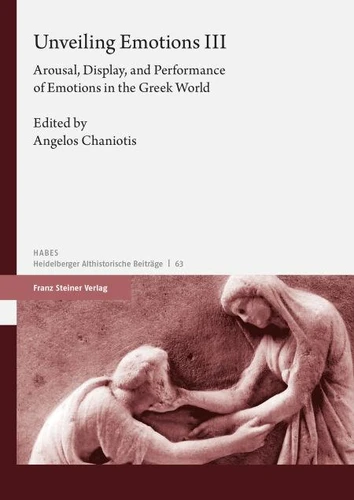
Unveiling Emotions. Vol. 3. Arousal, Display, and Performance of Emotions in the Greek World
Par :Formats :
Disponible dans votre compte client Decitre ou Furet du Nord dès validation de votre commande. Le format PDF est :
- Compatible avec une lecture sur My Vivlio (smartphone, tablette, ordinateur)
- Compatible avec une lecture sur liseuses Vivlio
- Pour les liseuses autres que Vivlio, vous devez utiliser le logiciel Adobe Digital Edition. Non compatible avec la lecture sur les liseuses Kindle, Remarkable et Sony
 , qui est-ce ?
Notre partenaire de plateforme de lecture numérique où vous retrouverez l'ensemble de vos ebooks gratuitement
Pour en savoir plus sur nos ebooks, consultez notre aide en ligne ici
C'est si simple ! Lisez votre ebook avec l'app Vivlio sur votre tablette, mobile ou ordinateur :

- Nombre de pages544
- FormatPDF
- ISBN978-3-515-12952-7
- EAN9783515129527
- Date de parution11/12/2020
- Protection num.Digital Watermarking
- Taille5 Mo
- Infos supplémentairespdf
- ÉditeurFranz Steiner
Résumé
The study of emotions has emerged in the last two decades as a major research subject in ancient studies. One of the primary aims of the study of emotions in the context of Greek and Roman Antiquity is to explore the means through which emotions are displayed and aroused, the contexts in which these media were applied, and the aims that they served. These are the themes addressed by the studies assembled in this volume, based on research conducted in association with a research project in Oxford.
The subjects discussed by the authors include the use of disgust for the stigmatization and marginalization of individuals and groups; the use of emotions such as anger, pity, hope, fear, and affection for the construction of social hierarchies and political fictions; the various means used for the arousal of emotions in drama, historiography, oratory, and art; emotional aspects in the work of Isocrates, Polybios, and Philostratos; the role of emotions in rhetorical training, court dramas, petitions, and magic; and the display and arousal of emotions in ancient pantomime.
The subjects discussed by the authors include the use of disgust for the stigmatization and marginalization of individuals and groups; the use of emotions such as anger, pity, hope, fear, and affection for the construction of social hierarchies and political fictions; the various means used for the arousal of emotions in drama, historiography, oratory, and art; emotional aspects in the work of Isocrates, Polybios, and Philostratos; the role of emotions in rhetorical training, court dramas, petitions, and magic; and the display and arousal of emotions in ancient pantomime.
A propos de Angelos Chaniotis
46,00 €