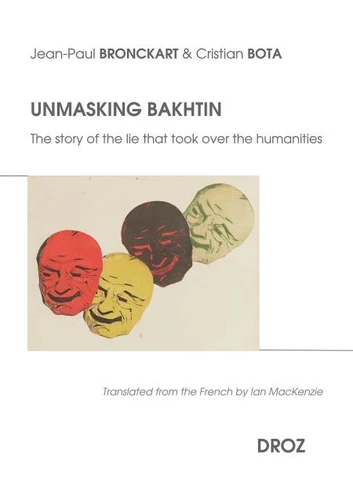
Unmasking Bakhtin. The story of the lie that took over the humanities
Par : , ,Formats :
Disponible dans votre compte client Decitre ou Furet du Nord dès validation de votre commande. Le format ePub est :
- Compatible avec une lecture sur My Vivlio (smartphone, tablette, ordinateur)
- Compatible avec une lecture sur liseuses Vivlio
- Pour les liseuses autres que Vivlio, vous devez utiliser le logiciel Adobe Digital Edition. Non compatible avec la lecture sur les liseuses Kindle, Remarkable et Sony
 , qui est-ce ?
Notre partenaire de plateforme de lecture numérique où vous retrouverez l'ensemble de vos ebooks gratuitement
Pour en savoir plus sur nos ebooks, consultez notre aide en ligne ici
C'est si simple ! Lisez votre ebook avec l'app Vivlio sur votre tablette, mobile ou ordinateur :

- Nombre de pages506
- FormatePub
- ISBN978-2-600-36020-3
- EAN9782600360203
- Date de parution01/01/2019
- Protection num.Digital Watermarking
- Taille825 Ko
- Infos supplémentairesepub
- ÉditeurLibrairie Droz
Résumé
The (presumed) author of books on Dostoevsky and Rabelais, Mikhail Bakhtin was elevated to the rank of "the greatest theoretician of literature in the twentieth century" by a two-pronged process: the publication of a number of his old manuscripts, and the assertion that he was also the true author of most of the texts published in the 1920s under the names of his "friends" P. N. Medvedev and V. N.
Voloshinov, who both died at an early age. Even though the theory of authorial substitution rests entirely on the declarations of Bakhtin, this dual process gave birth to the "Bakhtin Industry, " involving the elaboration of extremely creative hypotheses as to how exactly the works signed by his friends were written, and numerous studies aiming to demonstrate the unity and coherence of the Bakhtinian corpus.
But at the end of the 20th century, the publication of archival texts and interviews with Bakhtin revealed that he had lied about his biography and about his participation in the writing of the disputed texts. Further research showed that the supposed dates of his early manuscripts had been falsified, and that many of these writings consist largely of plagiarism. Jean-Paul Bronckart and Cristian Bota's conclusions lead us to investigate the motivations behind Bakhtin's usurpation of other people's work, as well as the true origin of the various texts that appeared under his name.
They also call for reflection as to why belief in the existence of a single and homogeneous Bakhtinian corpus persists among many literary scholars, alongside their continued celebration of its author's many-sided genius.
Voloshinov, who both died at an early age. Even though the theory of authorial substitution rests entirely on the declarations of Bakhtin, this dual process gave birth to the "Bakhtin Industry, " involving the elaboration of extremely creative hypotheses as to how exactly the works signed by his friends were written, and numerous studies aiming to demonstrate the unity and coherence of the Bakhtinian corpus.
But at the end of the 20th century, the publication of archival texts and interviews with Bakhtin revealed that he had lied about his biography and about his participation in the writing of the disputed texts. Further research showed that the supposed dates of his early manuscripts had been falsified, and that many of these writings consist largely of plagiarism. Jean-Paul Bronckart and Cristian Bota's conclusions lead us to investigate the motivations behind Bakhtin's usurpation of other people's work, as well as the true origin of the various texts that appeared under his name.
They also call for reflection as to why belief in the existence of a single and homogeneous Bakhtinian corpus persists among many literary scholars, alongside their continued celebration of its author's many-sided genius.
A propos de Cristian Bota
Le projet de Ferdinand de Saussure
Grand Format
33,63 €