
Carmela Patrias is a professor in the Department of History at Brock University. Her publications include: Patriots and Proletarians: Politicizing Hungarian Immigrants in Canada, Discounted Labour: Women Workers in Canada, 1870-1939, co-authored with Ruth Frager, and Jobs and Justice: Fighting Discrimination in Wartime Canada, 1939-1945.
Larry Savage is associate professor of labour studies and political science and director of the Jobs and Justice Research Unit at Brock University.
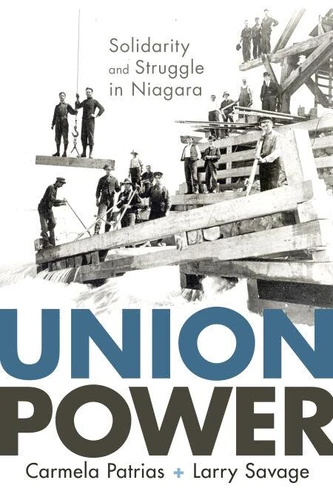
Union Power. Solidarity and Struggle in Niagara
Par : ,Formats :
Disponible dans votre compte client Decitre ou Furet du Nord dès validation de votre commande. Le format ePub est :
- Compatible avec une lecture sur My Vivlio (smartphone, tablette, ordinateur)
- Compatible avec une lecture sur liseuses Vivlio
- Pour les liseuses autres que Vivlio, vous devez utiliser le logiciel Adobe Digital Edition. Non compatible avec la lecture sur les liseuses Kindle, Remarkable et Sony
 , qui est-ce ?
Notre partenaire de plateforme de lecture numérique où vous retrouverez l'ensemble de vos ebooks gratuitement
Pour en savoir plus sur nos ebooks, consultez notre aide en ligne ici
C'est si simple ! Lisez votre ebook avec l'app Vivlio sur votre tablette, mobile ou ordinateur :

- Nombre de pages222
- FormatePub
- ISBN978-1-926836-80-5
- EAN9781926836805
- Date de parution01/05/2012
- Protection num.Digital Watermarking
- Taille6 Mo
- Infos supplémentairesepub
- ÉditeurAU Press and CCLH
Résumé
From factory workers in Welland to retail workers in St. Catharines, from hospitality workers in Niagara Falls to migrant farm workers in Niagara-On-The-Lake, Union Power showcases the role of working people in the Niagara region. Charting the development of the region's labour movement from the early nineteenth century to the present, Patrias and Savage illustrate how workers from this highly diversified economy struggled to improve their lives both inside and outside the workplace.
Including extensive quotations from interviews, archival sources, and local newspapers, the story unfolds, in part, through the voices of the people themselves: the workers who fought for unions, the community members who supported them, and the employers who opposed them. Early industrial development and the appalling working conditions of the often vulnerable common labourer prompted a movement toward worker protection.
Patrias and Savage argue that union power - power not built on profit, status, or prestige - relies on the twin concepts of struggle and solidarity: the solidarity of the shared interests of the working class and the struggle to achieve common goals. Union Power traces the evidence of these twin concepts through the history of the Niagara region's labour movement.
Including extensive quotations from interviews, archival sources, and local newspapers, the story unfolds, in part, through the voices of the people themselves: the workers who fought for unions, the community members who supported them, and the employers who opposed them. Early industrial development and the appalling working conditions of the often vulnerable common labourer prompted a movement toward worker protection.
Patrias and Savage argue that union power - power not built on profit, status, or prestige - relies on the twin concepts of struggle and solidarity: the solidarity of the shared interests of the working class and the struggle to achieve common goals. Union Power traces the evidence of these twin concepts through the history of the Niagara region's labour movement.
A propos de Carmela Patrias
16,99 €