SOLDES
Jusqu'à -70% sur une sélection d'articles*

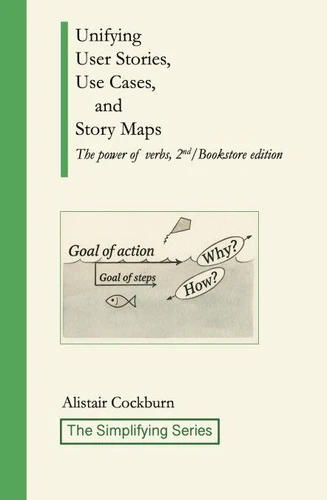
Unifying User Stories, Use Cases, and Story Maps: The Power of Verbs, 2nd/Bookstore edition. The Simplifying Series
Par :Formats :
Disponible dans votre compte client Decitre ou Furet du Nord dès validation de votre commande. Le format ePub est :
- Compatible avec une lecture sur My Vivlio (smartphone, tablette, ordinateur)
- Compatible avec une lecture sur liseuses Vivlio
- Pour les liseuses autres que Vivlio, vous devez utiliser le logiciel Adobe Digital Edition. Non compatible avec la lecture sur les liseuses Kindle, Remarkable et Sony
 , qui est-ce ?
Notre partenaire de plateforme de lecture numérique où vous retrouverez l'ensemble de vos ebooks gratuitement
Pour en savoir plus sur nos ebooks, consultez notre aide en ligne ici
C'est si simple ! Lisez votre ebook avec l'app Vivlio sur votre tablette, mobile ou ordinateur :

- FormatePub
- ISBN8998586262
- EAN9798998586262
- Date de parution03/12/2025
- Protection num.pas de protection
- Infos supplémentairesepub
- ÉditeurHumans and Technology Press
Résumé
Unifying User Stories, Use Cases, Story Maps: The Power of Verbs, Second Edition offers a comprehensive and cohesive explanation of three central techniques used in modern Agile requirements and product development. User stories, use cases, and story maps are widely adopted across teams, yet their relationships are often unclear. Many practitioners learn one technique without understanding how it complements the others, which leads to gaps in communication, inconsistent levels of detail, and misunderstandings that slow down delivery.
This book addresses those issues directly by presenting a unified foundation for all three approaches and showing how to move among them with confidence. The book begins with seven key concepts that form the shared backbone of user stories, use cases, and story maps. These concepts provide the grounding needed to write any of the three representations well. With this foundation established, each technique is examined in detail. The section on user stories clarifies their intended purpose, why they are written the way they are, and how they support effective conversations within Agile teams.
The section on use cases explains how to describe interactions step by step, revealing missing requirements and supporting design and testing. The section on story maps shows how to build a two-dimensional representation of user activities and tasks, helping teams see the overall flow of work and plan incremental releases. After presenting the techniques individually, the book integrates them. It explains how each technique brings a different perspective to the work of understanding users, describing system responsibilities, and planning delivery.
The unified approach makes it easier for practitioners to switch among the models depending on the needs of the moment and to maintain coherence as the conversation shifts from broad understanding to detailed exploration. This second edition refines the explanations of the seven key concepts, expands the examples used to illustrate the contrasts among the techniques, and reorganizes the sequence of topics to provide a smoother learning path.
Additional notes address questions raised by readers of the first edition, and the exercises and drills have been updated to strengthen self-study and classroom use. These improvements deepen the book's focus on clarity, practical application, and skill development. The book is intended for product owners, product managers, business analysts, UX designers, developers, testers, project managers, instructors, and Agile coaches.
It is suitable for newcomers who need a clear introduction to the three techniques, as well as experienced practitioners seeking to understand how the techniques relate and how to use them together. With its structured approach, practical guidance, and emphasis on foundational concepts, the book supports collaborative work and clearer communication across modern software development teams.
This book addresses those issues directly by presenting a unified foundation for all three approaches and showing how to move among them with confidence. The book begins with seven key concepts that form the shared backbone of user stories, use cases, and story maps. These concepts provide the grounding needed to write any of the three representations well. With this foundation established, each technique is examined in detail. The section on user stories clarifies their intended purpose, why they are written the way they are, and how they support effective conversations within Agile teams.
The section on use cases explains how to describe interactions step by step, revealing missing requirements and supporting design and testing. The section on story maps shows how to build a two-dimensional representation of user activities and tasks, helping teams see the overall flow of work and plan incremental releases. After presenting the techniques individually, the book integrates them. It explains how each technique brings a different perspective to the work of understanding users, describing system responsibilities, and planning delivery.
The unified approach makes it easier for practitioners to switch among the models depending on the needs of the moment and to maintain coherence as the conversation shifts from broad understanding to detailed exploration. This second edition refines the explanations of the seven key concepts, expands the examples used to illustrate the contrasts among the techniques, and reorganizes the sequence of topics to provide a smoother learning path.
Additional notes address questions raised by readers of the first edition, and the exercises and drills have been updated to strengthen self-study and classroom use. These improvements deepen the book's focus on clarity, practical application, and skill development. The book is intended for product owners, product managers, business analysts, UX designers, developers, testers, project managers, instructors, and Agile coaches.
It is suitable for newcomers who need a clear introduction to the three techniques, as well as experienced practitioners seeking to understand how the techniques relate and how to use them together. With its structured approach, practical guidance, and emphasis on foundational concepts, the book supports collaborative work and clearer communication across modern software development teams.
A propos de Alistair Cockburn




Love Trio Trio de Amor
E-book
6,99 €
