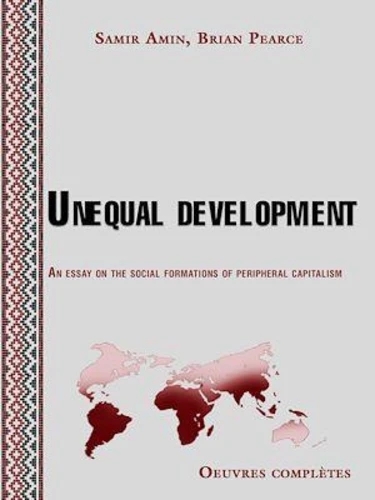
Unequal development. An essay on the social formations of peripheral capitalism
Par : ,Formats :
Disponible dans votre compte client Decitre ou Furet du Nord dès validation de votre commande. Le format ePub est :
- Compatible avec une lecture sur My Vivlio (smartphone, tablette, ordinateur)
- Compatible avec une lecture sur liseuses Vivlio
- Pour les liseuses autres que Vivlio, vous devez utiliser le logiciel Adobe Digital Edition. Non compatible avec la lecture sur les liseuses Kindle, Remarkable et Sony
 , qui est-ce ?
Notre partenaire de plateforme de lecture numérique où vous retrouverez l'ensemble de vos ebooks gratuitement
Pour en savoir plus sur nos ebooks, consultez notre aide en ligne ici
C'est si simple ! Lisez votre ebook avec l'app Vivlio sur votre tablette, mobile ou ordinateur :

- Nombre de pages954
- FormatePub
- ISBN978-2-37918-283-9
- EAN9782379182839
- Date de parution14/04/2020
- Protection num.Digital Watermarking
- Taille614 Ko
- Infos supplémentairesepub
- ÉditeurNENA
Résumé
Only at the end of the nineteenth century did a worldwide civilization begin to take shape. During the first seventy years of the twentieth century, however, which have been marked by a speeding up of the historical process, the division of the world into « developed » and « underdeveloped » countries has not become less pronounced; on the contrary, the gap between them continues to grow larger and has brought about the first crises of a capitalist system that had only just begun to be a world system.
The Russian Revolution of 1917, the Chinese Revolution that took place between 1930 and 1950, the revolutions in Vietnam and Cuba are all so many stages in a process of development beyond capitalism, in the name of socialism. The fears that Marx expressed in the middle of the last century, to the effect that a socialist Europe might find itself up against a capitalism still on the upgrade in Asia, have not proved justified.
The opposite, indeed, has occurred. At the very center of the system, however, in the advanced capitalist countries, an all-round challenging of this system has begun, through a thousand indirect and unexpected channels.(...)
The Russian Revolution of 1917, the Chinese Revolution that took place between 1930 and 1950, the revolutions in Vietnam and Cuba are all so many stages in a process of development beyond capitalism, in the name of socialism. The fears that Marx expressed in the middle of the last century, to the effect that a socialist Europe might find itself up against a capitalism still on the upgrade in Asia, have not proved justified.
The opposite, indeed, has occurred. At the very center of the system, however, in the advanced capitalist countries, an all-round challenging of this system has begun, through a thousand indirect and unexpected channels.(...)
A propos de Samir Amin


25,99 €





The future of Maoism
E-book
6,49 €

6,49 €

The arab economy today
E-book
6,00 €

6,49 €

The arab nation
E-book
6,49 €




The future of socialism
E-book
6,49 €

6,49 €


6,49 €