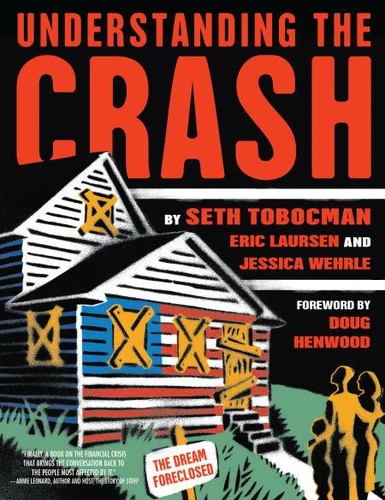
Understanding the Crash starts with a simple question that still haunts us all: What has happened to the world economy? With the kind of striking precision that only graphic nonfiction can provide, Seth Tobocman and Eric Laursen explain just how we got into this mess - and how we can get out of it. Looking back across more than a quarter century, the authors outline the roots of our current economic crisis.
They show how the troubles of a working-class community in Cleveland or a newly built suburb of Miami became an international financial crisis, explaining the complex new forms of credit that came into being because of financial deregulation, and how they created an economic whirlpool. From there they discuss how, over the same time span, a smaller and smaller group of people came to control a larger and larger percentage of the world's money - a result of rising inequality that, combined with the shortage of affordable housing, a decline in real wages, and our unwavering belief in an "ownership society, " impelled poor people into debt.
Tobocman and Laursen conclude with a consideration of a restructured financial system and a look toward a culture of sustainability - one that covets real wealth in the form of security, meaningful work, and community.
Understanding the Crash starts with a simple question that still haunts us all: What has happened to the world economy? With the kind of striking precision that only graphic nonfiction can provide, Seth Tobocman and Eric Laursen explain just how we got into this mess - and how we can get out of it. Looking back across more than a quarter century, the authors outline the roots of our current economic crisis.
They show how the troubles of a working-class community in Cleveland or a newly built suburb of Miami became an international financial crisis, explaining the complex new forms of credit that came into being because of financial deregulation, and how they created an economic whirlpool. From there they discuss how, over the same time span, a smaller and smaller group of people came to control a larger and larger percentage of the world's money - a result of rising inequality that, combined with the shortage of affordable housing, a decline in real wages, and our unwavering belief in an "ownership society, " impelled poor people into debt.
Tobocman and Laursen conclude with a consideration of a restructured financial system and a look toward a culture of sustainability - one that covets real wealth in the form of security, meaningful work, and community.


 , qui est-ce ?