SOLDES
Jusqu'à -70% sur une sélection d'articles*

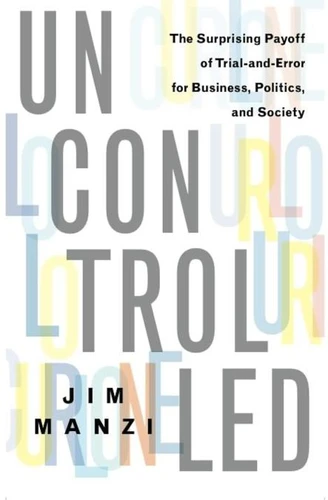
Uncontrolled. The Surprising Payoff of Trial-and-Error for Business, Politics, and Society
Par :Formats :
Disponible dans votre compte client Decitre ou Furet du Nord dès validation de votre commande. Le format ePub protégé est :
- Compatible avec une lecture sur My Vivlio (smartphone, tablette, ordinateur)
- Compatible avec une lecture sur liseuses Vivlio
- Pour les liseuses autres que Vivlio, vous devez utiliser le logiciel Adobe Digital Edition. Non compatible avec la lecture sur les liseuses Kindle, Remarkable et Sony
- Non compatible avec un achat hors France métropolitaine
 , qui est-ce ?
Notre partenaire de plateforme de lecture numérique où vous retrouverez l'ensemble de vos ebooks gratuitement
Pour en savoir plus sur nos ebooks, consultez notre aide en ligne ici
C'est si simple ! Lisez votre ebook avec l'app Vivlio sur votre tablette, mobile ou ordinateur :

- Nombre de pages320
- FormatePub
- ISBN978-0-465-02931-0
- EAN9780465029310
- Date de parution30/04/2012
- Protection num.Adobe DRM
- Infos supplémentairesepub
- ÉditeurBasic Books
Résumé
How do we know which social and economic policies work, which should be continued, and which should be changed? Jim Manzi argues that throughout history, various methods have been attempted -- except for controlled experimentation. Experiments provide the feedback loop that allows us, in certain limited ways, to identify error in our beliefs as a first step to correcting them. Over the course of the first half of the twentieth century, scientists invented a methodology for executing controlled experiments to evaluate certain kinds of proposed social interventions.
This technique goes by many names in different contexts (randomized control trials, randomized field experiments, clinical trials, etc.). Over the past ten to twenty years this has been increasingly deployed in a wide variety of contexts, but it remains the red-haired step child of modern social science. This is starting to change, and this change should be encouraged and accelerated, even though the staggering complexity of human society creates severe limits to what social science could be realistically expected to achieve.
Randomized trials have shown, for example, that work requirements for welfare recipients have succeeded like nothing else in encouraging employment, that charter school vouchers have been successful in increasing educational attainment for underprivileged children, and that community policing has worked to reduce crime, but also that programs like Head Start and Job Corps, which might be politically attractive, fail to attain their intended objectives.
Business leaders can also use experiments to test decisions in a controlled, low-risk environment before investing precious resources in large-scale changes -- the philosophy behind Manzi's own successful software company. In a powerful and masterfully-argued book, Manzi shows us how the methods of science can be applied to social and economic policy in order to ensure progress and prosperity.
This technique goes by many names in different contexts (randomized control trials, randomized field experiments, clinical trials, etc.). Over the past ten to twenty years this has been increasingly deployed in a wide variety of contexts, but it remains the red-haired step child of modern social science. This is starting to change, and this change should be encouraged and accelerated, even though the staggering complexity of human society creates severe limits to what social science could be realistically expected to achieve.
Randomized trials have shown, for example, that work requirements for welfare recipients have succeeded like nothing else in encouraging employment, that charter school vouchers have been successful in increasing educational attainment for underprivileged children, and that community policing has worked to reduce crime, but also that programs like Head Start and Job Corps, which might be politically attractive, fail to attain their intended objectives.
Business leaders can also use experiments to test decisions in a controlled, low-risk environment before investing precious resources in large-scale changes -- the philosophy behind Manzi's own successful software company. In a powerful and masterfully-argued book, Manzi shows us how the methods of science can be applied to social and economic policy in order to ensure progress and prosperity.