
George Dyson is a historian of technology and the author of several books including Turing's Cathedral, Project Orion and Darwin Among the Machines. His subjects range from the development (and redevelopment) of the Aleut kayak to the evolution of artificial intelligence.
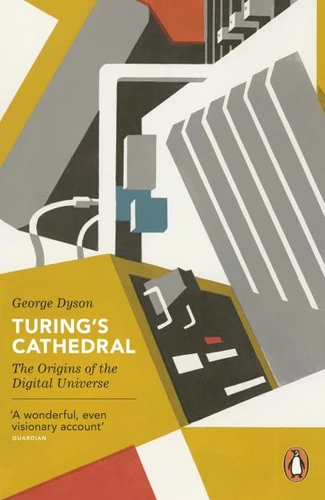
Turing's Cathedral. The Origins of the Digital Universe
Par :Formats :
Disponible dans votre compte client Decitre ou Furet du Nord dès validation de votre commande. Le format ePub protégé est :
- Compatible avec une lecture sur My Vivlio (smartphone, tablette, ordinateur)
- Compatible avec une lecture sur liseuses Vivlio
- Pour les liseuses autres que Vivlio, vous devez utiliser le logiciel Adobe Digital Edition. Non compatible avec la lecture sur les liseuses Kindle, Remarkable et Sony
- Non compatible avec un achat hors France métropolitaine
 , qui est-ce ?
Notre partenaire de plateforme de lecture numérique où vous retrouverez l'ensemble de vos ebooks gratuitement
Pour en savoir plus sur nos ebooks, consultez notre aide en ligne ici
C'est si simple ! Lisez votre ebook avec l'app Vivlio sur votre tablette, mobile ou ordinateur :

- Nombre de pages432
- FormatePub
- ISBN978-0-7181-9450-5
- EAN9780718194505
- Date de parution01/03/2012
- Protection num.Adobe DRM
- Infos supplémentairesepub
- ÉditeurPENGUIN
Résumé
How did computers take over the world? In late 1945, a small group of brilliant engineers and mathematicians gathered at the newly created Institute for Advanced Study in Princeton, New Jersey. Their ostensible goal was to build a computer which would be instrumental in the US government's race to create a hydrogen bomb. The mathematicians themselves, however, saw their project as the realization of Alan Turing's theoretical 'universal machine.' In Turing's Cathedral, George Dyson vividly re-creates the intense experimentation, incredible mathematical insight and pure creative genius that led to the dawn of the digital universe, uncovering a wealth of new material to bring a human story of extraordinary men and women and their ideas to life.
From the lowliest iPhone app to Google's sprawling metazoan codes, we now live in a world of self-replicating numbers and self-reproducing machines whose origins go back to a 5-kilobyte matrix that still holds clues as to what may lie ahead.
From the lowliest iPhone app to Google's sprawling metazoan codes, we now live in a world of self-replicating numbers and self-reproducing machines whose origins go back to a 5-kilobyte matrix that still holds clues as to what may lie ahead.
A propos de George Dyson
9,49 €