
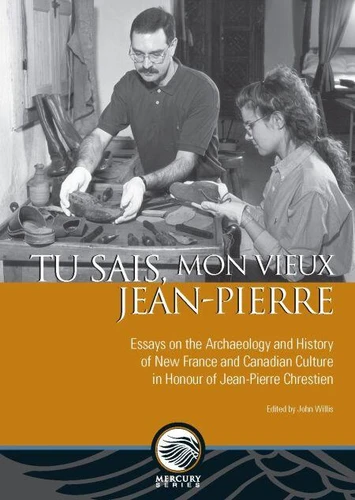
Tu sais, mon vieux Jean-Pierre. Essays on the Archaeology and History of New France and Canadian Culture
Par :Formats :
Disponible dans votre compte client Decitre ou Furet du Nord dès validation de votre commande. Le format PDF est :
- Compatible avec une lecture sur My Vivlio (smartphone, tablette, ordinateur)
- Compatible avec une lecture sur liseuses Vivlio
- Pour les liseuses autres que Vivlio, vous devez utiliser le logiciel Adobe Digital Edition. Non compatible avec la lecture sur les liseuses Kindle, Remarkable et Sony
 , qui est-ce ?
Notre partenaire de plateforme de lecture numérique où vous retrouverez l'ensemble de vos ebooks gratuitement
Pour en savoir plus sur nos ebooks, consultez notre aide en ligne ici
C'est si simple ! Lisez votre ebook avec l'app Vivlio sur votre tablette, mobile ou ordinateur :

- Nombre de pages448
- FormatPDF
- ISBN978-0-7766-2458-7
- EAN9780776624587
- Date de parution28/04/2017
- Protection num.pas de protection
- Taille21 Mo
- Infos supplémentairespdf
- ÉditeurMercury-Mercure
- EditeurJohn Willis
Résumé
Tu sais, mon vieux Jean-Pierre is inspired by the work of archaeologist Jean-Pierre Chrestien (1949-2008), who worked hand-in-glove with a generation of researchers in helping to unearth unexpected and always interesting aspects of New France. Contributions focus first upon the door to New France in the Gulf of St. Lawrence, Newfoundland and Acadia. A second set of essays move further up the St. Lawrence and into the heartland of the continent.
The final section examines aspects of Canadian culture: popular art, religion and communication. The essays share a curiosity for material culture, a careful regard for detail and nuance that forms the grain of New France studies, and sensitivity to the overall context that is part and parcel of how historyproceeds on the local or regional scale. Happily we can now dispense with old-fashioned and facile generalizations about the allegedly absent bourgeoisie, the purportedly deficient commercial ethic of the habitants and the so-called underlying military character of the colony and get down the business of understanding real people and their possessions in context.
Published in French.
The final section examines aspects of Canadian culture: popular art, religion and communication. The essays share a curiosity for material culture, a careful regard for detail and nuance that forms the grain of New France studies, and sensitivity to the overall context that is part and parcel of how historyproceeds on the local or regional scale. Happily we can now dispense with old-fashioned and facile generalizations about the allegedly absent bourgeoisie, the purportedly deficient commercial ethic of the habitants and the so-called underlying military character of the colony and get down the business of understanding real people and their possessions in context.
Published in French.