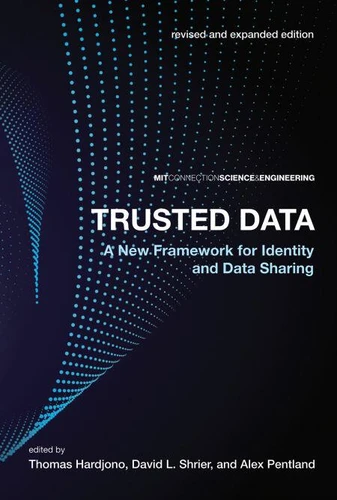
How to create an Internet of Trusted Data in which insights from data can be extracted without collecting, holding, or revealing the underlying data. Trusted Data describes a data architecture that places humans and their societal values at the center of the discussion. By involving people from all parts of the ecosystem of information, this new approach allows us to realize the benefits of data-driven algorithmic decision making while minimizing the risks and unintended consequences.
It proposes a software architecture and legal framework for an Internet of Trusted Data that provides safe, secure access for everyone and protects against bias, unfairness, and other unintended effects. This approach addresses issues of data privacy, security, ownership, and trust by allowing insights to be extracted from data held by different people, companies, or governments without collecting, holding, or revealing the underlying data.
The software architecture, called Open Algorithms, or OPAL, sends algorithms to databases rather than copying or sharing data. The data is protected by existing firewalls; only encrypted results are shared. Data never leaves its repository. A higher security architecture, ENIGMA, built on OPAL, is fully encrypted. ContributorsMichiel Bakker, Yves-Alexandre de Montjoye, Daniel Greenwood, Thomas Hardjoni, Jake Kendall, Cameron Kerry, Bruno Lepri, Alexander Lipton, Takeo Nishikata, Alejandro Noriega-Campero, Nuria Oliver, Alex Pentland, David L.
Shrier, Jacopo Staiano, Guy ZyskindAn MIT Connection Science and Engineering Book
How to create an Internet of Trusted Data in which insights from data can be extracted without collecting, holding, or revealing the underlying data. Trusted Data describes a data architecture that places humans and their societal values at the center of the discussion. By involving people from all parts of the ecosystem of information, this new approach allows us to realize the benefits of data-driven algorithmic decision making while minimizing the risks and unintended consequences.
It proposes a software architecture and legal framework for an Internet of Trusted Data that provides safe, secure access for everyone and protects against bias, unfairness, and other unintended effects. This approach addresses issues of data privacy, security, ownership, and trust by allowing insights to be extracted from data held by different people, companies, or governments without collecting, holding, or revealing the underlying data.
The software architecture, called Open Algorithms, or OPAL, sends algorithms to databases rather than copying or sharing data. The data is protected by existing firewalls; only encrypted results are shared. Data never leaves its repository. A higher security architecture, ENIGMA, built on OPAL, is fully encrypted. ContributorsMichiel Bakker, Yves-Alexandre de Montjoye, Daniel Greenwood, Thomas Hardjoni, Jake Kendall, Cameron Kerry, Bruno Lepri, Alexander Lipton, Takeo Nishikata, Alejandro Noriega-Campero, Nuria Oliver, Alex Pentland, David L.
Shrier, Jacopo Staiano, Guy ZyskindAn MIT Connection Science and Engineering Book

 , qui est-ce ?
