SOLDES
Jusqu'à -70% sur une sélection d'articles*

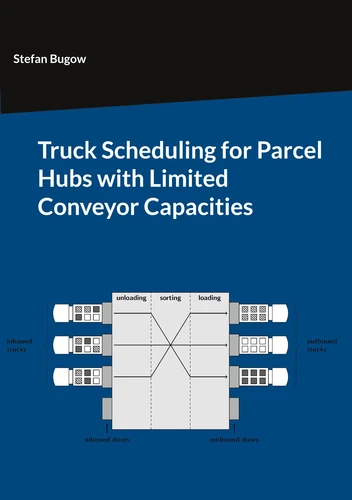
Truck Scheduling for Parcel Hubs with Limited Conveyor Capacities
Par :Formats :
Disponible dans votre compte client Decitre ou Furet du Nord dès validation de votre commande. Le format PDF est :
- Compatible avec une lecture sur My Vivlio (smartphone, tablette, ordinateur)
- Compatible avec une lecture sur liseuses Vivlio
- Pour les liseuses autres que Vivlio, vous devez utiliser le logiciel Adobe Digital Edition. Non compatible avec la lecture sur les liseuses Kindle, Remarkable et Sony
 , qui est-ce ?
Notre partenaire de plateforme de lecture numérique où vous retrouverez l'ensemble de vos ebooks gratuitement
Pour en savoir plus sur nos ebooks, consultez notre aide en ligne ici
C'est si simple ! Lisez votre ebook avec l'app Vivlio sur votre tablette, mobile ou ordinateur :

- Nombre de pages186
- FormatPDF
- ISBN978-3-7578-3170-7
- EAN9783757831707
- Date de parution16/02/2023
- Protection num.Digital Watermarking
- Taille2 Mo
- Infos supplémentairespdf
- ÉditeurBooks on Demand
Résumé
In the postal service industry, parcel hubs are widely used to consolidate freight on an intermediate stage of the distribution network. By consolidating parcels, the utilization of trucks is increased, transportation costs can be reduced and shorter delivery times can be achieved. The internal transfer of parcels in these parcel hubs is mainly conducted on capacity-constrained conveyor systems. Individual conveyors can easily be overburdened in case a multitude of incoming trucks with a large number of parcels designated for the same conveyor are unloaded concurrently.
Thus, scheduling incoming trucks efficiently is crucial for the operational performance of the parcel hub. This book explores different approaches to optimize the truck scheduling problem at parcel hubs by developing several mathematical optimization models. Further, the author illustrates efficient algorithms to solve the mathematical problem and designs a simulation model to further investigate the problem setting.
The results show that optimized truck schedules have the potential to significantly improve the operational performance of parcel hubs.
Thus, scheduling incoming trucks efficiently is crucial for the operational performance of the parcel hub. This book explores different approaches to optimize the truck scheduling problem at parcel hubs by developing several mathematical optimization models. Further, the author illustrates efficient algorithms to solve the mathematical problem and designs a simulation model to further investigate the problem setting.
The results show that optimized truck schedules have the potential to significantly improve the operational performance of parcel hubs.