
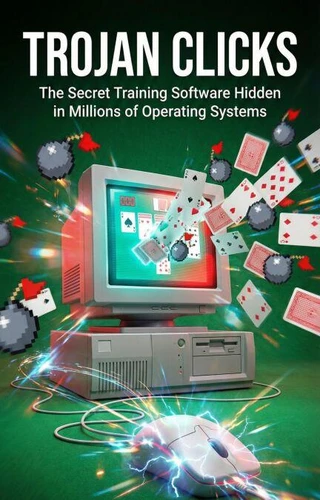
Trojan Clicks. The Secret Training Software Hidden in Millions of Operating Systems
Par :Formats :
Disponible dans votre compte client Decitre ou Furet du Nord dès validation de votre commande. Le format ePub est :
- Compatible avec une lecture sur My Vivlio (smartphone, tablette, ordinateur)
- Compatible avec une lecture sur liseuses Vivlio
- Pour les liseuses autres que Vivlio, vous devez utiliser le logiciel Adobe Digital Edition. Non compatible avec la lecture sur les liseuses Kindle, Remarkable et Sony
 , qui est-ce ?
Notre partenaire de plateforme de lecture numérique où vous retrouverez l'ensemble de vos ebooks gratuitement
Pour en savoir plus sur nos ebooks, consultez notre aide en ligne ici
C'est si simple ! Lisez votre ebook avec l'app Vivlio sur votre tablette, mobile ou ordinateur :

- Nombre de pages134
- FormatePub
- ISBN978-3-565-26954-9
- EAN9783565269549
- Date de parution24/02/2026
- Protection num.pas de protection
- Taille671 Ko
- Infos supplémentairesepub
- ÉditeurEmphaloz Publishing House
Résumé
When Microsoft released early versions of Windows, they included simple games like Solitaire and Minesweeper. For decades, millions of office workers lost countless hours to these digital distractions. But these games were not included merely for entertainment; they were covert training programs designed to rewire human muscle memory.
This technological history uncovers the brilliant user-interface strategy behind early operating systems.
In the early 1990s, the computer mouse was an alien concept. Solitaire was specifically engineered to teach users the fluid mechanics of "drag and drop, " while Minesweeper was designed to train speed and precision with the "left and right click." By examining the diaries of early software engineers, the book reveals how these simple games bridged the massive psychological gap between analog typewriters and digital interfaces.
It explores how hidden gamification successfully taught an entire generation a new language of physical interaction without them ever realizing they were in a classroom. Revisit the grey screens that shaped our digital dexterity. This narrative proves that the most effective technological revolutions are the ones disguised as pure play.
In the early 1990s, the computer mouse was an alien concept. Solitaire was specifically engineered to teach users the fluid mechanics of "drag and drop, " while Minesweeper was designed to train speed and precision with the "left and right click." By examining the diaries of early software engineers, the book reveals how these simple games bridged the massive psychological gap between analog typewriters and digital interfaces.
It explores how hidden gamification successfully taught an entire generation a new language of physical interaction without them ever realizing they were in a classroom. Revisit the grey screens that shaped our digital dexterity. This narrative proves that the most effective technological revolutions are the ones disguised as pure play.