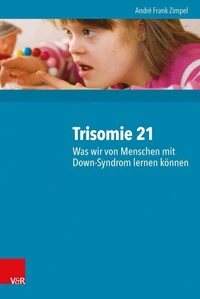
Trisomy 21. What we can learn from people with Down syndrome
Par : , , , ,Formats :
Disponible dans votre compte client Decitre ou Furet du Nord dès validation de votre commande. Le format PDF est :
- Compatible avec une lecture sur My Vivlio (smartphone, tablette, ordinateur)
- Compatible avec une lecture sur liseuses Vivlio
- Pour les liseuses autres que Vivlio, vous devez utiliser le logiciel Adobe Digital Edition. Non compatible avec la lecture sur les liseuses Kindle, Remarkable et Sony
 , qui est-ce ?
Notre partenaire de plateforme de lecture numérique où vous retrouverez l'ensemble de vos ebooks gratuitement
Pour en savoir plus sur nos ebooks, consultez notre aide en ligne ici
C'est si simple ! Lisez votre ebook avec l'app Vivlio sur votre tablette, mobile ou ordinateur :

- Nombre de pages212
- FormatPDF
- ISBN978-3-647-70196-7
- EAN9783647701967
- Date de parution11/07/2016
- Protection num.pas de protection
- Taille4 Mo
- Infos supplémentairespdf
- ÉditeurVandenhoeck & Ruprecht
Résumé
For a long time, it was assumed that a genetic disposition such as trisomy 21 enables predictions to be made about overall personality development. But, who could have ever imagined that people with trisomy 21 (Down syndrome) would also be capable of earning a university degree? We studied 1, 294 people with trisomy 21. The results showed that people with trisomy 21 benefit more from abstract learning than their neurotypical counterparts.
Two-year-olds with the syndrome first learn to read and only then to speak and will understand algebra better than arithmetic. Ignorance of neurodiversity inevitably leads to learning difficulties when these people are forced to learn at the same pace as others. This applies to autism and trisomy 21 to the same extent. That is why this book advocates the recognition of trisomy 21 as a variant in the spectrum of human neurodiversity.
Two-year-olds with the syndrome first learn to read and only then to speak and will understand algebra better than arithmetic. Ignorance of neurodiversity inevitably leads to learning difficulties when these people are forced to learn at the same pace as others. This applies to autism and trisomy 21 to the same extent. That is why this book advocates the recognition of trisomy 21 as a variant in the spectrum of human neurodiversity.
A propos de André Frank Zimpel

28,00 €

12,00 €