
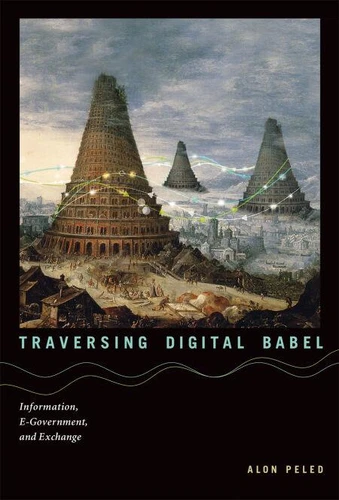
Traversing Digital Babel. Information, E-Government, and Exchange
Par :Formats :
Disponible dans votre compte client Decitre ou Furet du Nord dès validation de votre commande. Le format ePub protégé est :
- Compatible avec une lecture sur My Vivlio (smartphone, tablette, ordinateur)
- Compatible avec une lecture sur liseuses Vivlio
- Pour les liseuses autres que Vivlio, vous devez utiliser le logiciel Adobe Digital Edition. Non compatible avec la lecture sur les liseuses Kindle, Remarkable et Sony
- Non compatible avec un achat hors France métropolitaine
 , qui est-ce ?
Notre partenaire de plateforme de lecture numérique où vous retrouverez l'ensemble de vos ebooks gratuitement
Pour en savoir plus sur nos ebooks, consultez notre aide en ligne ici
C'est si simple ! Lisez votre ebook avec l'app Vivlio sur votre tablette, mobile ou ordinateur :

- Nombre de pages296
- FormatePub
- ISBN978-0-262-31987-4
- EAN9780262319874
- Date de parution19/09/2014
- Protection num.Adobe DRM
- Taille4 Mo
- Infos supplémentairesepub
- ÉditeurThe MIT Press
Résumé
A groundbreaking approach to information sharing among government agencies: using selective incentives to "nudge" them to exchange information assets. The computer systems of government agencies are notoriously complex. New technologies are piled on older technologies, creating layers that call to mind an archaeological dig. Obsolete programming languages and closed mainframe designs offer barriers to integration with other agency systems.
Worldwide, these unwieldy systems waste billions of dollars, keep citizens from receiving services, and even-as seen in interoperability failures on 9/11 and during Hurricane Katrina-cost lives. In this book, Alon Peled offers a groundbreaking approach for enabling information sharing among public sector agencies: using selective incentives to "nudge" agencies to exchange information assets. Peled proposes the establishment of a Public Sector Information Exchange (PSIE), through which agencies would trade information.
After describing public sector information sharing failures and the advantages of incentivized sharing, Peled examines the U. S. Open Data program, and the gap between its rhetoric and results. He offers examples of creative public sector information sharing in the United States, Australia, Brazil, the Netherlands, and Iceland. Peled argues that information is a contested commodity, and draws lessons from the trade histories of other contested commodities-including cadavers for anatomical dissection in nineteenth-century Britain.
He explains how agencies can exchange information as a contested commodity through a PSIE program tailored to an individual country's needs, and he describes the legal, economic, and technical foundations of such a program. Touching on issues from data ownership to freedom of information, Peled offers pragmatic advice to politicians, bureaucrats, technologists, and citizens for revitalizing critical information flows.
Worldwide, these unwieldy systems waste billions of dollars, keep citizens from receiving services, and even-as seen in interoperability failures on 9/11 and during Hurricane Katrina-cost lives. In this book, Alon Peled offers a groundbreaking approach for enabling information sharing among public sector agencies: using selective incentives to "nudge" agencies to exchange information assets. Peled proposes the establishment of a Public Sector Information Exchange (PSIE), through which agencies would trade information.
After describing public sector information sharing failures and the advantages of incentivized sharing, Peled examines the U. S. Open Data program, and the gap between its rhetoric and results. He offers examples of creative public sector information sharing in the United States, Australia, Brazil, the Netherlands, and Iceland. Peled argues that information is a contested commodity, and draws lessons from the trade histories of other contested commodities-including cadavers for anatomical dissection in nineteenth-century Britain.
He explains how agencies can exchange information as a contested commodity through a PSIE program tailored to an individual country's needs, and he describes the legal, economic, and technical foundations of such a program. Touching on issues from data ownership to freedom of information, Peled offers pragmatic advice to politicians, bureaucrats, technologists, and citizens for revitalizing critical information flows.