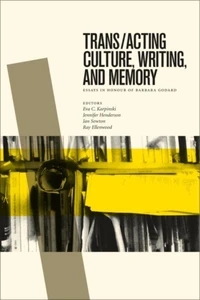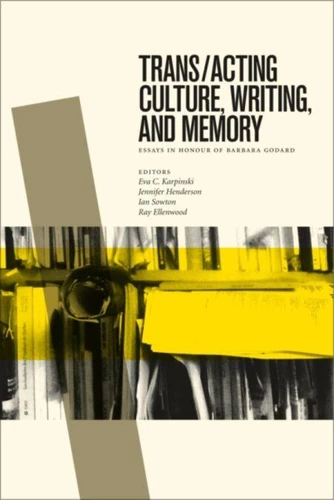
Trans/acting Culture, Writing, and Memory. Essays in Honour of Barbara Godard
Par : , , ,Formats :
Disponible dans votre compte client Decitre ou Furet du Nord dès validation de votre commande. Le format ePub est :
- Compatible avec une lecture sur My Vivlio (smartphone, tablette, ordinateur)
- Compatible avec une lecture sur liseuses Vivlio
- Pour les liseuses autres que Vivlio, vous devez utiliser le logiciel Adobe Digital Edition. Non compatible avec la lecture sur les liseuses Kindle, Remarkable et Sony
 , qui est-ce ?
Notre partenaire de plateforme de lecture numérique où vous retrouverez l'ensemble de vos ebooks gratuitement
Pour en savoir plus sur nos ebooks, consultez notre aide en ligne ici
C'est si simple ! Lisez votre ebook avec l'app Vivlio sur votre tablette, mobile ou ordinateur :

- Nombre de pages394
- FormatePub
- ISBN978-1-55458-863-3
- EAN9781554588633
- Date de parution30/10/2013
- Protection num.Digital Watermarking
- Taille3 Mo
- Infos supplémentairesepub
- ÉditeurWilfrid Laurier University Press
Résumé
Trans/acting Culture, Writing, and Memory is a collection of essays written in honour of Barbara Godard, one of the most original and wide-ranging literary critics, theorists, teachers, translators, and public intellectuals Canada has ever produced. The contributors, both established and emerging scholars, extend Godard's work through engagements with her published texts in the spirit of creative interchange and intergenerational relay of ideas.
Their essays resonate with Godard's innovative scholarship, situated at the intersection of such fields as literary studies, cultural studies, translation studies, feminist theory, arts criticism, social activism, institutional analysis, and public memory. In pursuit of unexpected linkages and connections, the essays venture beyond generic and disciplinary borders, zeroing in on Godard's transdisciplinary practice which has been extremely influential in the way it framed questions and modelled interventions for the study of Canadian, Québécois, and Acadian literatures and cultures.
The authors work with the materials ranging from Canadian government policies and documents to publications concerning white-supremacist organizations in Southern Ontario, online materials from a Toronto-based transgender arts festival, a photographic mural installation commemorating the Montreal Massacre, and the works of such writers and artists as Marie Clements, Nicole Brossard, France Daigle, Nancy Huston, Yvette Nolan, Gail Scott, Denise Desautels, Louise Warren, Rebecca Belmore, Vera Frenkel, Robert Lepage, and Janet Cardiff.
Their essays resonate with Godard's innovative scholarship, situated at the intersection of such fields as literary studies, cultural studies, translation studies, feminist theory, arts criticism, social activism, institutional analysis, and public memory. In pursuit of unexpected linkages and connections, the essays venture beyond generic and disciplinary borders, zeroing in on Godard's transdisciplinary practice which has been extremely influential in the way it framed questions and modelled interventions for the study of Canadian, Québécois, and Acadian literatures and cultures.
The authors work with the materials ranging from Canadian government policies and documents to publications concerning white-supremacist organizations in Southern Ontario, online materials from a Toronto-based transgender arts festival, a photographic mural installation commemorating the Montreal Massacre, and the works of such writers and artists as Marie Clements, Nicole Brossard, France Daigle, Nancy Huston, Yvette Nolan, Gail Scott, Denise Desautels, Louise Warren, Rebecca Belmore, Vera Frenkel, Robert Lepage, and Janet Cardiff.