SOLDES
Jusqu'à -70% sur une sélection d'articles*

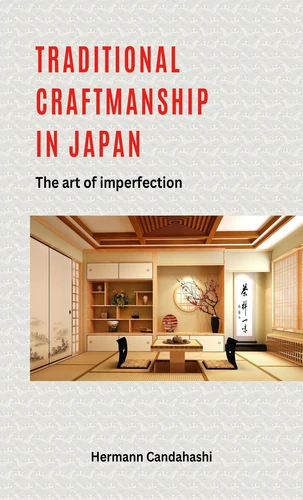
Traditional craftsmanship in Japan - The Art of Imperfection
Par :Formats :
Disponible dans votre compte client Decitre ou Furet du Nord dès validation de votre commande. Le format ePub est :
- Compatible avec une lecture sur My Vivlio (smartphone, tablette, ordinateur)
- Compatible avec une lecture sur liseuses Vivlio
- Pour les liseuses autres que Vivlio, vous devez utiliser le logiciel Adobe Digital Edition. Non compatible avec la lecture sur les liseuses Kindle, Remarkable et Sony
 , qui est-ce ?
Notre partenaire de plateforme de lecture numérique où vous retrouverez l'ensemble de vos ebooks gratuitement
Pour en savoir plus sur nos ebooks, consultez notre aide en ligne ici
C'est si simple ! Lisez votre ebook avec l'app Vivlio sur votre tablette, mobile ou ordinateur :

- FormatePub
- ISBN8224746545
- EAN9798224746545
- Date de parution17/01/2024
- Protection num.pas de protection
- Infos supplémentairesepub
- ÉditeurDraft2Digital
Résumé
Dear readers, I am pleased to present to you, after a longer time of research and preparation, my new book on Japanese craftsmanship. Like the creations within it, this book adheres to the principle of Wabi-Sabi and cannot illuminate all facets and characteristics of this vast realm of Japanese traditions. Nevertheless, it may be suitable to inspire you to further explore aspects of these fascinating art forms.
If I succeed in this with you, I would have achieved my goal. Japanese craftsmanship possesses the unique ability to blend artistry and functionality. It spans from the traditional tea ceremony to intricately crafted ceramics, from finely carved woodwork to breathtaking textiles. These traditions are passed down from generation to generation, serving as expressions not only of skill but also of deep cultural and religious significance.
Imperfection in them is not seen as failure, as it might be in Western countries, but rather as a path to a rarely attained perfection. A key aspect of Japanese craftsmanship is the reverence for nature and simplicity. Many artisans draw inspiration from nature, whether it be the elegant line of a bonsai tree or the flowing movement of a koi fish. This connection to nature is reflected not only in the motifs but also in the materials used.
Wood, bamboo, paper, and silk often form the foundation for these artistic creations. The transmission of craftsmanship occurs in specialized workshops, where masters of their craft pass on their skills to apprentices. These apprenticeships are characterized by dedication, discipline, and a profound respect for the craft. Apprentices not only learn the technical skills but also the philosophy behind each technique.
It is this fusion of technique and spirituality that makes Japanese craftsmanship truly unique. One of the most fascinating examples of traditional craftsmanship in Japan is the art of Kintsugi, the repair of ceramics with a mixture of gold or silver lacquer. Instead of hiding the breakages, they are accentuated with precious metals, adding not only an aesthetic element but also conveying a philosophical message - the beauty of repair and the appreciation for the impermanent.
In the upcoming chapters, we will delve into the various facets of Japanese craftsmanship, from the intricate Noh masks to the precise artistry of Samurai swords. Join us on a journey through centuries of tradition and innovation as we explore the legacy of Japanese craftsmanship.
If I succeed in this with you, I would have achieved my goal. Japanese craftsmanship possesses the unique ability to blend artistry and functionality. It spans from the traditional tea ceremony to intricately crafted ceramics, from finely carved woodwork to breathtaking textiles. These traditions are passed down from generation to generation, serving as expressions not only of skill but also of deep cultural and religious significance.
Imperfection in them is not seen as failure, as it might be in Western countries, but rather as a path to a rarely attained perfection. A key aspect of Japanese craftsmanship is the reverence for nature and simplicity. Many artisans draw inspiration from nature, whether it be the elegant line of a bonsai tree or the flowing movement of a koi fish. This connection to nature is reflected not only in the motifs but also in the materials used.
Wood, bamboo, paper, and silk often form the foundation for these artistic creations. The transmission of craftsmanship occurs in specialized workshops, where masters of their craft pass on their skills to apprentices. These apprenticeships are characterized by dedication, discipline, and a profound respect for the craft. Apprentices not only learn the technical skills but also the philosophy behind each technique.
It is this fusion of technique and spirituality that makes Japanese craftsmanship truly unique. One of the most fascinating examples of traditional craftsmanship in Japan is the art of Kintsugi, the repair of ceramics with a mixture of gold or silver lacquer. Instead of hiding the breakages, they are accentuated with precious metals, adding not only an aesthetic element but also conveying a philosophical message - the beauty of repair and the appreciation for the impermanent.
In the upcoming chapters, we will delve into the various facets of Japanese craftsmanship, from the intricate Noh masks to the precise artistry of Samurai swords. Join us on a journey through centuries of tradition and innovation as we explore the legacy of Japanese craftsmanship.