
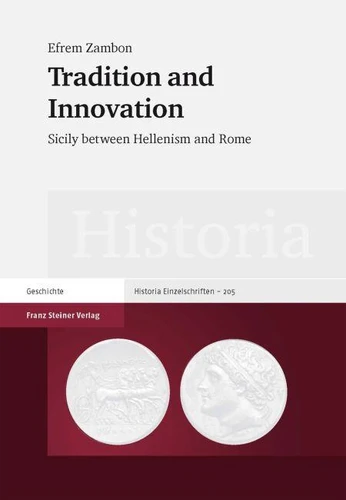
Efrem Zambon, born in Venice 1971. Degree in Classics at Venice University "Ca' Foscari" 1995; PhD in Ancient History at Rome University "La Sapienza" 2001; Post-doctoral award at Padua University 2001. Fields of interest: Greek History (Hellenistic age; the Western Greeks; Alexander the Great; the Successors and Greece).
Tradition and Innovation. Sicily between Hellenism and Rome
Par :Formats :
Disponible dans votre compte client Decitre ou Furet du Nord dès validation de votre commande. Le format PDF est :
- Compatible avec une lecture sur My Vivlio (smartphone, tablette, ordinateur)
- Compatible avec une lecture sur liseuses Vivlio
- Pour les liseuses autres que Vivlio, vous devez utiliser le logiciel Adobe Digital Edition. Non compatible avec la lecture sur les liseuses Kindle, Remarkable et Sony
 , qui est-ce ?
Notre partenaire de plateforme de lecture numérique où vous retrouverez l'ensemble de vos ebooks gratuitement
Pour en savoir plus sur nos ebooks, consultez notre aide en ligne ici
C'est si simple ! Lisez votre ebook avec l'app Vivlio sur votre tablette, mobile ou ordinateur :

- Nombre de pages326
- FormatPDF
- ISBN978-3-515-09545-7
- EAN9783515095457
- Date de parution03/07/2012
- Protection num.Digital Watermarking
- Taille3 Mo
- Infos supplémentairespdf
- ÉditeurFranz Steiner
Résumé
At the beginning of the Hellenistic Age, Sicily became the landing-place for political innovations produced by Hellenistic culture in the West - and very soon it turned out to be the theatre for the comparison of different ethnicities: Sicilian natives, Greeks, Italics, Carthaginians and Romans.
This book investigates the decades between 289 and 241 B. C. and the social as well as political development of Sicily by re-examining crucial events that made the island the first Roman provincia after the first Punic War: the failure of the first Hellenistic kingship in the West; the Sicilian expedition of Pyrrhus; the new Hellenistic kingship of Hiero of Syracuse; the first Punic War and the victory of Rome.
Also, this study highlights how successfully the political modernization and the social innovations of the Hellenistic Age took place in Sicilian cities - and the way some novelties were rejected and some traditional institutions still existed, even after the complete Roman conquest.
Also, this study highlights how successfully the political modernization and the social innovations of the Hellenistic Age took place in Sicilian cities - and the way some novelties were rejected and some traditional institutions still existed, even after the complete Roman conquest.