SOLDES
Jusqu'à -70% sur une sélection d'articles*

Nouveauté
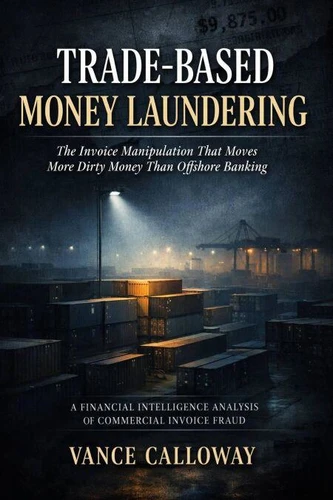
Trade-Based Money Laundering: The Invoice Manipulation That Moves More Dirty Money Than Offshore Banking
Par :Formats :
Disponible dans votre compte client Decitre ou Furet du Nord dès validation de votre commande. Le format ePub est :
- Compatible avec une lecture sur My Vivlio (smartphone, tablette, ordinateur)
- Compatible avec une lecture sur liseuses Vivlio
- Pour les liseuses autres que Vivlio, vous devez utiliser le logiciel Adobe Digital Edition. Non compatible avec la lecture sur les liseuses Kindle, Remarkable et Sony
 , qui est-ce ?
Notre partenaire de plateforme de lecture numérique où vous retrouverez l'ensemble de vos ebooks gratuitement
Pour en savoir plus sur nos ebooks, consultez notre aide en ligne ici
C'est si simple ! Lisez votre ebook avec l'app Vivlio sur votre tablette, mobile ou ordinateur :

- FormatePub
- ISBN8235302433
- EAN9798235302433
- Date de parution01/07/2026
- Protection num.pas de protection
- Infos supplémentairesepub
- ÉditeurIoakim Ioakim
Résumé
Every cargo ship crossing the ocean tonight carries something almost nobody thinks to question: a number written on a piece of paper. A price. And on a portion of those shipments, that single number is a lie engineered to move criminal fortunes across national borders without a single bank ever flagging it. This is trade-based money laundering, the technique financial intelligence analysts now identify as the largest channel for dirty money on the planet.
Larger than offshore banking. Larger than cash smuggling. Larger than cryptocurrency. It does not hide in the shadows of the dark web. It hides inside the most ordinary document in global commerce: the commercial invoice. Trade-Based Money Laundering takes you inside the machine itself, transaction by transaction. You will see how a routine shipment of blue jeans into Los Angeles unraveled an eighty million dollar laundering network.
You will follow the Black Market Peso Exchange as it moved billions of narcotics dollars through ordinary American storefronts, electronics, appliances, used cars, without a single dollar in cash ever crossing a border. You will sit beside the compliance officers reviewing hundreds of letters of credit a week, hunting for the one price that does not belong among thousands that do. You will walk the corridors where this trade has thrived for decades, Miami to Bogota, Hong Kong to Shenzhen, Dubai to Lagos, Karachi to the Gulf, and meet the brokers, shell companies, and front men who keep it running.
This is not a textbook, and it is not speculation. Every case, every figure, every red flag indicator in this book is drawn from public court records, financial intelligence reports, and the documented findings of agencies including FinCEN, the Financial Action Task Force, the Egmont Group, and the U. S. Government Accountability Office. Nothing is dramatized. Nothing is invented. The story is disturbing enough without embellishment.
What you will walk away with is not just a true crime narrative but a working understanding of how money actually moves when it needs to disappear, why customs officials and bankers so often cannot stop it, and what reforms have actually worked and which have failed. Written for readers who devour financial thrillers and investigative journalism alike, this book moves with the pace of a heist story while delivering the precision of a financial intelligence briefing.
By the final page, you will never look at an ordinary invoice, a used car export, or a shipment of gold the same way again. You will see the number on the page, and you will know exactly what it might be hiding.
Larger than offshore banking. Larger than cash smuggling. Larger than cryptocurrency. It does not hide in the shadows of the dark web. It hides inside the most ordinary document in global commerce: the commercial invoice. Trade-Based Money Laundering takes you inside the machine itself, transaction by transaction. You will see how a routine shipment of blue jeans into Los Angeles unraveled an eighty million dollar laundering network.
You will follow the Black Market Peso Exchange as it moved billions of narcotics dollars through ordinary American storefronts, electronics, appliances, used cars, without a single dollar in cash ever crossing a border. You will sit beside the compliance officers reviewing hundreds of letters of credit a week, hunting for the one price that does not belong among thousands that do. You will walk the corridors where this trade has thrived for decades, Miami to Bogota, Hong Kong to Shenzhen, Dubai to Lagos, Karachi to the Gulf, and meet the brokers, shell companies, and front men who keep it running.
This is not a textbook, and it is not speculation. Every case, every figure, every red flag indicator in this book is drawn from public court records, financial intelligence reports, and the documented findings of agencies including FinCEN, the Financial Action Task Force, the Egmont Group, and the U. S. Government Accountability Office. Nothing is dramatized. Nothing is invented. The story is disturbing enough without embellishment.
What you will walk away with is not just a true crime narrative but a working understanding of how money actually moves when it needs to disappear, why customs officials and bankers so often cannot stop it, and what reforms have actually worked and which have failed. Written for readers who devour financial thrillers and investigative journalism alike, this book moves with the pace of a heist story while delivering the precision of a financial intelligence briefing.
By the final page, you will never look at an ordinary invoice, a used car export, or a shipment of gold the same way again. You will see the number on the page, and you will know exactly what it might be hiding.