
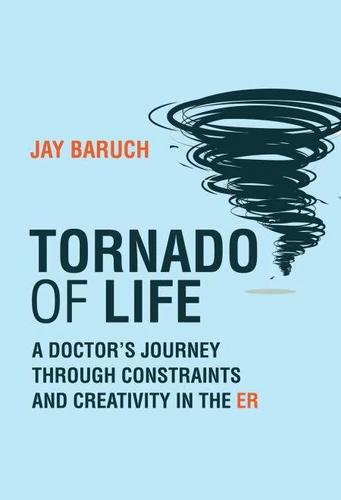
Tornado of Life. A Doctor's Journey through Constraints and Creativity in the ER
Par :Formats :
Disponible dans votre compte client Decitre ou Furet du Nord dès validation de votre commande. Le format ePub protégé est :
- Compatible avec une lecture sur My Vivlio (smartphone, tablette, ordinateur)
- Compatible avec une lecture sur liseuses Vivlio
- Pour les liseuses autres que Vivlio, vous devez utiliser le logiciel Adobe Digital Edition. Non compatible avec la lecture sur les liseuses Kindle, Remarkable et Sony
- Non compatible avec un achat hors France métropolitaine
 , qui est-ce ?
Notre partenaire de plateforme de lecture numérique où vous retrouverez l'ensemble de vos ebooks gratuitement
Pour en savoir plus sur nos ebooks, consultez notre aide en ligne ici
C'est si simple ! Lisez votre ebook avec l'app Vivlio sur votre tablette, mobile ou ordinateur :

- Nombre de pages320
- FormatePub
- ISBN978-0-262-37010-3
- EAN9780262370103
- Date de parution30/08/2022
- Protection num.Adobe DRM
- Taille350 Ko
- Infos supplémentairesepub
- ÉditeurThe MIT Press
Résumé
"BRIEF, TOUCHING" STORIES FROM THE ER: An emergency room doctor shows how empathy, creativity, and imagination are the cornerstones of clinical care (New York Times Book Review). To be an emergency room doctor is to be a professional listener to stories. Each patient presents a story; finding the heart of that story is the doctor's most critical task. More technology, more tests, and more data won't work if doctors get the story wrong.
When caring for others can feel like venturing into uncharted territory without a map, empathy, creativity, imagination, and thinking like a writer become the cornerstones of clinical care. In Tornado of Life, ER physician Jay Baruch shares these struggles in a series of short, powerful, and affecting essays that invite the reader into stories rich with complexity and messiness. Patients come to the ER with lives troubled by scales of misfortune that have little to do with disease or injury.
ER doctors must be problem-finders before they are problem-solvers. Cheryl, for example, whose story is a chaos narrative of "and this happened, and then that happened, and then, and then and then and then, " tells Baruch she is "stuck in a tornado of life." What will help her, and what will help Mr. K., who seems like a textbook case of post-combat PTSD but turns out not to be? Baruch describes, among other things, the emergency of loneliness (invoking Chekhov, another doctor-writer); his own (frightening) experience as a patient; the patient who demanded a hug; and emergency medicine during COVID-19.
These stories often end without closure or solutions. The patients are discharged into the world. But if they're lucky, the doctor has listened to their stories as well as treated them.
When caring for others can feel like venturing into uncharted territory without a map, empathy, creativity, imagination, and thinking like a writer become the cornerstones of clinical care. In Tornado of Life, ER physician Jay Baruch shares these struggles in a series of short, powerful, and affecting essays that invite the reader into stories rich with complexity and messiness. Patients come to the ER with lives troubled by scales of misfortune that have little to do with disease or injury.
ER doctors must be problem-finders before they are problem-solvers. Cheryl, for example, whose story is a chaos narrative of "and this happened, and then that happened, and then, and then and then and then, " tells Baruch she is "stuck in a tornado of life." What will help her, and what will help Mr. K., who seems like a textbook case of post-combat PTSD but turns out not to be? Baruch describes, among other things, the emergency of loneliness (invoking Chekhov, another doctor-writer); his own (frightening) experience as a patient; the patient who demanded a hug; and emergency medicine during COVID-19.
These stories often end without closure or solutions. The patients are discharged into the world. But if they're lucky, the doctor has listened to their stories as well as treated them.