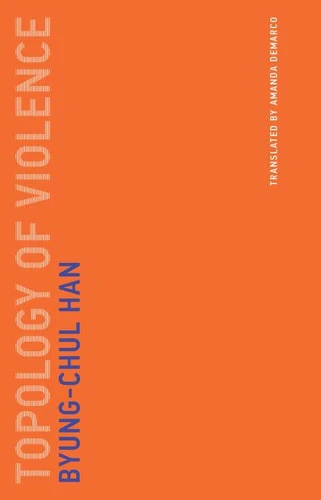
One of today's most widely read philosophers considers the shift in violence from visible to invisible, from negativity to excess of positivity. Some things never disappear-violence, for example. Violence is ubiquitous and incessant but protean, varying its outward form according to the social constellation at hand. In Topology of Violence, the philosopher Byung-Chul Han considers the shift in violence from the visible to the invisible, from the frontal to the viral to the self-inflicted, from brute force to mediated force, from the real to the virtual.
Violence, Han tells us, has gone from the negative-explosive, massive, and martial-to the positive, wielded without enmity or domination. This, he says, creates the false impression that violence has disappeared. Anonymized, desubjectified, systemic, violence conceals itself because it has become one with society. Han first investigates the macro-physical manifestations of violence, which take the form of negativity-developing from the tension between self and other, interior and exterior, friend and enemy.
These manifestations include the archaic violence of sacrifice and blood, the mythical violence of jealous and vengeful gods, the deadly violence of the sovereign, the merciless violence of torture, the bloodless violence of the gas chamber, the viral violence of terrorism, and the verbal violence of hurtful language. He then examines the violence of positivity-the expression of an excess of positivity-which manifests itself as over-achievement, over-production, over-communication, hyper-attention, and hyperactivity.
The violence of positivity, Han warns, could be even more disastrous than that of negativity. Infection, invasion, and infiltration have given way to infarction.
One of today's most widely read philosophers considers the shift in violence from visible to invisible, from negativity to excess of positivity. Some things never disappear-violence, for example. Violence is ubiquitous and incessant but protean, varying its outward form according to the social constellation at hand. In Topology of Violence, the philosopher Byung-Chul Han considers the shift in violence from the visible to the invisible, from the frontal to the viral to the self-inflicted, from brute force to mediated force, from the real to the virtual.
Violence, Han tells us, has gone from the negative-explosive, massive, and martial-to the positive, wielded without enmity or domination. This, he says, creates the false impression that violence has disappeared. Anonymized, desubjectified, systemic, violence conceals itself because it has become one with society. Han first investigates the macro-physical manifestations of violence, which take the form of negativity-developing from the tension between self and other, interior and exterior, friend and enemy.
These manifestations include the archaic violence of sacrifice and blood, the mythical violence of jealous and vengeful gods, the deadly violence of the sovereign, the merciless violence of torture, the bloodless violence of the gas chamber, the viral violence of terrorism, and the verbal violence of hurtful language. He then examines the violence of positivity-the expression of an excess of positivity-which manifests itself as over-achievement, over-production, over-communication, hyper-attention, and hyperactivity.
The violence of positivity, Han warns, could be even more disastrous than that of negativity. Infection, invasion, and infiltration have given way to infarction.


 , qui est-ce ?