SOLDES
Jusqu'à -70% sur une sélection d'articles*

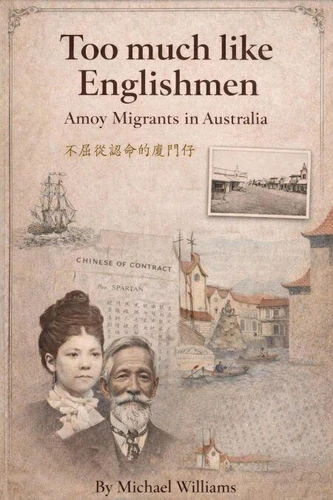
Too much like Englishmen: Amoy Migrants in Australia
Par :Formats :
Disponible dans votre compte client Decitre ou Furet du Nord dès validation de votre commande. Le format ePub est :
- Compatible avec une lecture sur My Vivlio (smartphone, tablette, ordinateur)
- Compatible avec une lecture sur liseuses Vivlio
- Pour les liseuses autres que Vivlio, vous devez utiliser le logiciel Adobe Digital Edition. Non compatible avec la lecture sur les liseuses Kindle, Remarkable et Sony
 , qui est-ce ?
Notre partenaire de plateforme de lecture numérique où vous retrouverez l'ensemble de vos ebooks gratuitement
Pour en savoir plus sur nos ebooks, consultez notre aide en ligne ici
C'est si simple ! Lisez votre ebook avec l'app Vivlio sur votre tablette, mobile ou ordinateur :

- FormatePub
- ISBN978-1-7635605-9-8
- EAN9781763560598
- Date de parution30/01/2026
- Protection num.pas de protection
- Infos supplémentairesepub
- ÉditeurChideStudy Press
Résumé
Too much like Englishmen uncovers a forgotten migration that reshaped colonial Australia long before the gold rushes made Chinese migration visible. Between 1848 and 1853, more than 3, 000 men from Amoy-modern Xiamen in China's Fujian province-were recruited under five-year labour contracts and sent to New South Wales. Drawn into the expanding British imperial labour market after the First Opium War opened Amoy as a treaty port, these men were dispatched to the pastoral frontier, where they worked as shepherds on remote stations struggling to replace convict labour.
Their recruitment was often opaque and coercive, their voyages arduous, and their lives in Australia profoundly disparate. Some endured exploitation, isolation, and violence; others resisted mistreatment, adapted to new conditions, and forged lives beyond the terms of their contracts. Tensions surrounding abusive recruitment practices erupted in the Amoy riots of 1852, abruptly ending organised labour migration from the port to Australia.
When their contracts expired, these men did not simply vanish from history. Some moved on to the goldfields, but many remained in rural Australia, marrying locally, becoming naturalized, and establishing families whose descendants live in Australia today. Long eclipsed by later Cantonese migration and distorted by the enduring stereotype of "coolie" labour, their experiences have been marginalised or misunderstood.
Drawing on newly uncovered archival records and family histories, Too much like Englishmen restores these men to the centre of Australia's colonial story, revealing a complex history of resilience, agency, and belonging.
Their recruitment was often opaque and coercive, their voyages arduous, and their lives in Australia profoundly disparate. Some endured exploitation, isolation, and violence; others resisted mistreatment, adapted to new conditions, and forged lives beyond the terms of their contracts. Tensions surrounding abusive recruitment practices erupted in the Amoy riots of 1852, abruptly ending organised labour migration from the port to Australia.
When their contracts expired, these men did not simply vanish from history. Some moved on to the goldfields, but many remained in rural Australia, marrying locally, becoming naturalized, and establishing families whose descendants live in Australia today. Long eclipsed by later Cantonese migration and distorted by the enduring stereotype of "coolie" labour, their experiences have been marginalised or misunderstood.
Drawing on newly uncovered archival records and family histories, Too much like Englishmen restores these men to the centre of Australia's colonial story, revealing a complex history of resilience, agency, and belonging.
A propos de Michael Williams
2,99 €

3,49 €

Great Kids in History
E-book
0,99 €
2,99 €
2,99 €
2,99 €

3,99 €
4,99 €

4,99 €
4,99 €

Dead Sols
E-book
1,99 €

1,99 €

Elementary Concerns
E-book
0,99 €