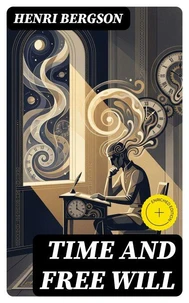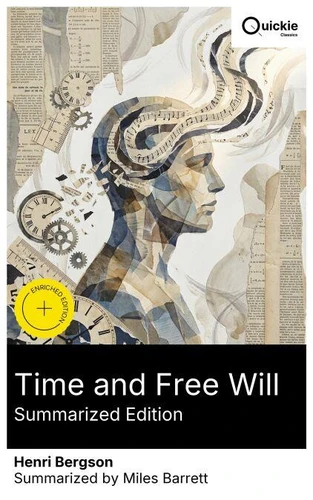
Time and Free Will (Summarized Edition). Enriched edition. A philosophical essay on duration, time perception, and the metaphysics of freedom in continental thought
Par : , ,Formats :
Disponible dans votre compte client Decitre ou Furet du Nord dès validation de votre commande. Le format ePub est :
- Compatible avec une lecture sur My Vivlio (smartphone, tablette, ordinateur)
- Compatible avec une lecture sur liseuses Vivlio
- Pour les liseuses autres que Vivlio, vous devez utiliser le logiciel Adobe Digital Edition. Non compatible avec la lecture sur les liseuses Kindle, Remarkable et Sony
 , qui est-ce ?
Notre partenaire de plateforme de lecture numérique où vous retrouverez l'ensemble de vos ebooks gratuitement
Pour en savoir plus sur nos ebooks, consultez notre aide en ligne ici
C'est si simple ! Lisez votre ebook avec l'app Vivlio sur votre tablette, mobile ou ordinateur :

- Nombre de pages99
- FormatePub
- ISBN859-65--4787966-4
- EAN8596547879664
- Date de parution10/01/2026
- Protection num.Digital Watermarking
- Taille830 Ko
- Infos supplémentairesepub
- ÉditeurCosimo Publishing
Résumé
Time and Free Will argues that lived time (durée) is a qualitative flow, not the homogeneous, spatialized time of mechanics. Through analyses of intensity, the interpenetration of mental states, and the famous melody example, Bergson critiques psychophysics' arithmetic of the mind and the determinism it supports. In lucid, image-rich prose, the essay straddles psychology and metaphysics, opposing late nineteenth-century positivism and associationism while inaugurating a distinct method of intuition.
Henri Bergson (1859-1941), trained in mathematics at the École Normale Supérieure and shaped by Ravaisson and Boutroux, submitted this study as part of his 1889 doctoral theses. Dissatisfied with how calculus and physics spatialize time, and informed by close reading of psychophysics and British empiricism, he sought the immediate data of consciousness. These concerns anticipate his later accounts of memory and creative evolution, which would earn him the 1927 Nobel Prize.
Recommended to readers probing freedom, agency, and temporality-from philosophers of mind and phenomenologists to psychologists wary of reductionism-this classic equips them with a precise vocabulary and vivid examples. Clear yet conceptually daring, it remains a compelling point of departure for rethinking what it means to live in time. Quickie Classics summarizes timeless works with precision, preserving the author's voice and keeping the prose clear, fast, and readable-distilled, never diluted.
Enriched Edition extras: Introduction · Synopsis · Historical Context · Author Biography · Brief Analysis · 4 Reflection Q&As · Editorial Footnotes.
Henri Bergson (1859-1941), trained in mathematics at the École Normale Supérieure and shaped by Ravaisson and Boutroux, submitted this study as part of his 1889 doctoral theses. Dissatisfied with how calculus and physics spatialize time, and informed by close reading of psychophysics and British empiricism, he sought the immediate data of consciousness. These concerns anticipate his later accounts of memory and creative evolution, which would earn him the 1927 Nobel Prize.
Recommended to readers probing freedom, agency, and temporality-from philosophers of mind and phenomenologists to psychologists wary of reductionism-this classic equips them with a precise vocabulary and vivid examples. Clear yet conceptually daring, it remains a compelling point of departure for rethinking what it means to live in time. Quickie Classics summarizes timeless works with precision, preserving the author's voice and keeping the prose clear, fast, and readable-distilled, never diluted.
Enriched Edition extras: Introduction · Synopsis · Historical Context · Author Biography · Brief Analysis · 4 Reflection Q&As · Editorial Footnotes.