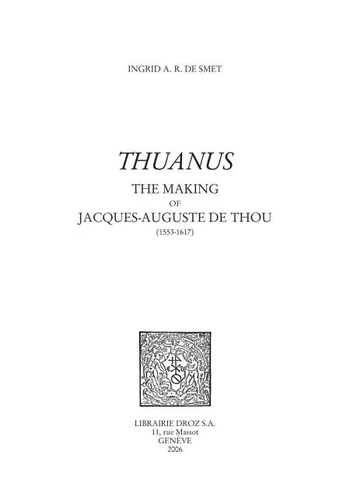
Thuanus. The making of Jacques-Auguste de Thou (1553-1617).
Par :Formats :
Disponible dans votre compte client Decitre ou Furet du Nord dès validation de votre commande. Le format ePub est :
- Compatible avec une lecture sur My Vivlio (smartphone, tablette, ordinateur)
- Compatible avec une lecture sur liseuses Vivlio
- Pour les liseuses autres que Vivlio, vous devez utiliser le logiciel Adobe Digital Edition. Non compatible avec la lecture sur les liseuses Kindle, Remarkable et Sony
 , qui est-ce ?
Notre partenaire de plateforme de lecture numérique où vous retrouverez l'ensemble de vos ebooks gratuitement
Pour en savoir plus sur nos ebooks, consultez notre aide en ligne ici
C'est si simple ! Lisez votre ebook avec l'app Vivlio sur votre tablette, mobile ou ordinateur :

- Nombre de pages352
- FormatePub
- ISBN978-2-600-31071-0
- EAN9782600310710
- Date de parution01/06/2008
- Protection num.Digital Watermarking
- Taille5 Mo
- Infos supplémentairesepub
- ÉditeurLibrairie Droz
Résumé
The Parisian magistrate Jacques-Auguste de Thou (1553-1617) was a major figure in the French Wars of Religion (1562-1598) and their immediate aftermath. Best known for his magisterial History of his own times (covering 1546-1607) and his complementary Memoirs (covering 1553-1601), de Thou was a key political negotiator, a famous book-collector and an influential patron to scholars and writers, as well as a respected poet in his own right and a prolific correspondent.
This is the first monograph on de Thou since Samuel Kinser's bibliographical study of 1966. In the course of five chapters, thematically arranged between a substantial introduction and a dramatic conclusion, Ingrid De Smet meticulously unpicks de Thou's strategies of self-fashioning and career enhancement as well as the conditions that led to his fall from grace. In doing so, this monograph not only rehabilitates de Thou as a creative (neo-Latin) writer of international allure, it also uncovers and contextualizes the complexities of de Thou's life, writings, and thought.
This is the first monograph on de Thou since Samuel Kinser's bibliographical study of 1966. In the course of five chapters, thematically arranged between a substantial introduction and a dramatic conclusion, Ingrid De Smet meticulously unpicks de Thou's strategies of self-fashioning and career enhancement as well as the conditions that led to his fall from grace. In doing so, this monograph not only rehabilitates de Thou as a creative (neo-Latin) writer of international allure, it also uncovers and contextualizes the complexities of de Thou's life, writings, and thought.