
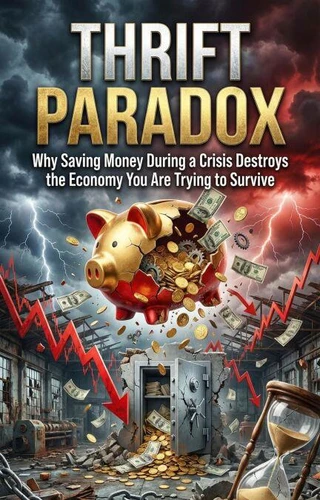
Thrift Paradox. Why Saving Money During a Crisis Destroys the Economy You Are Trying to Survive
Par :Formats :
Disponible dans votre compte client Decitre ou Furet du Nord dès validation de votre commande. Le format ePub est :
- Compatible avec une lecture sur My Vivlio (smartphone, tablette, ordinateur)
- Compatible avec une lecture sur liseuses Vivlio
- Pour les liseuses autres que Vivlio, vous devez utiliser le logiciel Adobe Digital Edition. Non compatible avec la lecture sur les liseuses Kindle, Remarkable et Sony
 , qui est-ce ?
Notre partenaire de plateforme de lecture numérique où vous retrouverez l'ensemble de vos ebooks gratuitement
Pour en savoir plus sur nos ebooks, consultez notre aide en ligne ici
C'est si simple ! Lisez votre ebook avec l'app Vivlio sur votre tablette, mobile ou ordinateur :

- Nombre de pages146
- FormatePub
- ISBN978-3-565-27521-2
- EAN9783565275212
- Date de parution26/02/2026
- Protection num.pas de protection
- Taille819 Ko
- Infos supplémentairesepub
- ÉditeurEmphaloz Publishing House
Résumé
When a financial crisis hits, the most rational, responsible thing an individual or a business can do is to cut back on spending and save money. It is the fundamental rule of personal finance. Yet, when millions of people and corporations make this exact same rational decision simultaneously, it triggers an economic catastrophe. This is the cruel irony of macroeconomics: the Paradox of Thrift.
Coined by John Maynard Keynes, this paradox illustrates how individual prudence leads to collective ruin.
If everyone hoards cash, consumer demand plummets. When demand plummets, businesses stop producing and start laying off workers. Those unemployed workers then have even less money, causing demand to shrink further. The very act of attempting to save money shrinks the entire economy, ultimately leaving everyone-including the cautious savers-poorer than before. This deep macroeconomic analysis dissects the mechanics of demand collapse.
It examines historical case studies, from the Great Depression to the 2008 financial crisis, showcasing how central banks and governments desperately try to break this vicious cycle of hoarding. For economists, investors, and business leaders, this book provides essential clarity on the friction between micro-level logic and macro-level disaster. Understand the paradox to better anticipate government interventions and protect your wealth during the next inevitable downturn.
If everyone hoards cash, consumer demand plummets. When demand plummets, businesses stop producing and start laying off workers. Those unemployed workers then have even less money, causing demand to shrink further. The very act of attempting to save money shrinks the entire economy, ultimately leaving everyone-including the cautious savers-poorer than before. This deep macroeconomic analysis dissects the mechanics of demand collapse.
It examines historical case studies, from the Great Depression to the 2008 financial crisis, showcasing how central banks and governments desperately try to break this vicious cycle of hoarding. For economists, investors, and business leaders, this book provides essential clarity on the friction between micro-level logic and macro-level disaster. Understand the paradox to better anticipate government interventions and protect your wealth during the next inevitable downturn.