
Né en 1953, Daniel Cohen est économiste, agrégé de mathématiques et de sciences économiques, docteur en sciences économiques.
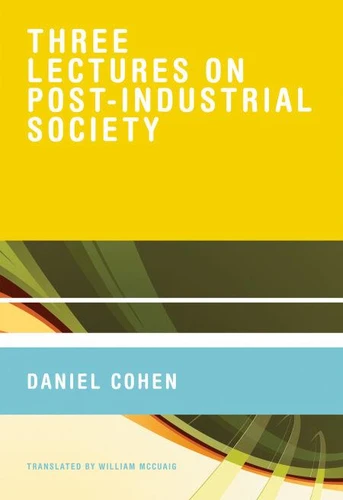
Three Lectures on Post-Industrial Society
Par : ,Formats :
Disponible dans votre compte client Decitre ou Furet du Nord dès validation de votre commande. Le format ePub protégé est :
- Compatible avec une lecture sur My Vivlio (smartphone, tablette, ordinateur)
- Compatible avec une lecture sur liseuses Vivlio
- Pour les liseuses autres que Vivlio, vous devez utiliser le logiciel Adobe Digital Edition. Non compatible avec la lecture sur les liseuses Kindle, Remarkable et Sony
- Non compatible avec un achat hors France métropolitaine
 , qui est-ce ?
Notre partenaire de plateforme de lecture numérique où vous retrouverez l'ensemble de vos ebooks gratuitement
Pour en savoir plus sur nos ebooks, consultez notre aide en ligne ici
C'est si simple ! Lisez votre ebook avec l'app Vivlio sur votre tablette, mobile ou ordinateur :

- Nombre de pages120
- FormatePub
- ISBN978-0-262-26666-6
- EAN9780262266666
- Date de parution29/08/2008
- Protection num.Adobe DRM
- Taille119 Ko
- Infos supplémentairesepub
- ÉditeurThe MIT Press
Résumé
A noted economist analyzes the upheavals caused by revolutions in technology, labor, culture, financial markets, and globalization. In this pithy and provocative book, noted economist Daniel Cohen offers his analysis of the global shift to a post-industrial era. If it was once natural to speak of industrial society, Cohen writes, it is more difficult to speak meaningfully of post-industrial "society." The solidarity that once lay at the heart of industrial society no longer exists.
The different levels of large industrial enterprises have been systematically disassembled: tasks considered nonessential are assigned to subcontractors; engineers are grouped together in research sites, apart from the workers. Employees are left exposed while shareholders act to protect themselves. Never has the awareness that we all live in the same world been so strong-and never have the social conditions of existence been so unequal.
In these wide-ranging reflections, Cohen describes the transformations that signaled the break between the industrial and the post-industrial eras. He links the revolution in information technology to the trend toward flatter hierarchies of workers with multiple skills-and connects the latter to work practices growing out of the culture of the May 1968 protests. Subcontracting and outsourcing have also changed the nature of work, and Cohen succinctly analyzes the new international division of labor, the economic rise of China, India, and the former Soviet Union, and the economic effects of free trade on poor countries.
Finally, Cohen examines the fate of the European social model-with its traditional compromise between social justice and economic productivity-in a post-industrial world.
The different levels of large industrial enterprises have been systematically disassembled: tasks considered nonessential are assigned to subcontractors; engineers are grouped together in research sites, apart from the workers. Employees are left exposed while shareholders act to protect themselves. Never has the awareness that we all live in the same world been so strong-and never have the social conditions of existence been so unequal.
In these wide-ranging reflections, Cohen describes the transformations that signaled the break between the industrial and the post-industrial eras. He links the revolution in information technology to the trend toward flatter hierarchies of workers with multiple skills-and connects the latter to work practices growing out of the culture of the May 1968 protests. Subcontracting and outsourcing have also changed the nature of work, and Cohen succinctly analyzes the new international division of labor, the economic rise of China, India, and the former Soviet Union, and the economic effects of free trade on poor countries.
Finally, Cohen examines the fate of the European social model-with its traditional compromise between social justice and economic productivity-in a post-industrial world.
A propos de Daniel Cohen

6,90 €
Macroéconomie
8e édition
Grand Format
49,00 €

7,40 €

Homo numericus. La "civilisation" qui vient
Grand Format
20,90 €



8,50 €
9,20 €
11,50 €


12,38 €
4/5
Le monde est clos et le désir infini - Occasion
Grand Format
9,84 €