
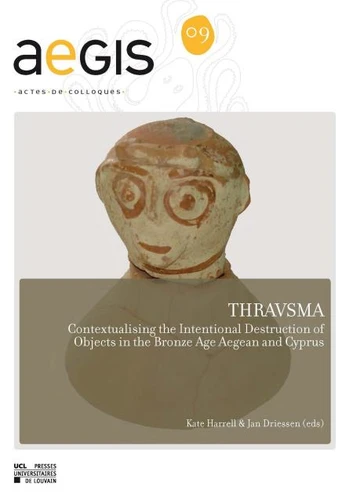
Thravsma. Contextualising the Intentional Destruction of Objects in the Bronze Age Aegean and Cyprus
Par : ,Formats :
Disponible dans votre compte client Decitre ou Furet du Nord dès validation de votre commande. Le format Multi-format est :
- Pour les liseuses autres que Vivlio, vous devez utiliser le logiciel Adobe Digital Edition. Non compatible avec la lecture sur les liseuses Kindle, Remarkable et Sony
 , qui est-ce ?
Notre partenaire de plateforme de lecture numérique où vous retrouverez l'ensemble de vos ebooks gratuitement
Pour en savoir plus sur nos ebooks, consultez notre aide en ligne ici
C'est si simple ! Lisez votre ebook avec l'app Vivlio sur votre tablette, mobile ou ordinateur :

- Nombre de pages196
- FormatMulti-format
- ISBN978-2-87558-540-0
- EAN9782875585400
- Date de parution17/08/2017
- Protection num.pas de protection
- Infos supplémentairesMulti-Format
- ÉditeurPresses universitaires de Louvai...
Résumé
How does intentionally inflicting damage to material objects mediate the human experience in the prehistoric eastern Mediterranean? For all of the diversity in cultural practice in the civilisations of the Greek mainland and Aegean islands, Crete, Cyprus and the eastern coast of Italy between 4000-750 BC, archaeologists consider the custom of ritually killing objects as a normative, if inconsistent practice.
Yet as artefacts that are alike only in that they have been disarticulated, intentionally destroyed objects defy easy characterization. Such pieces frequently stand outside of clearly defined patterns. This volume is an initial step in addressing a gap in the scholarship by aiming to deconstruct and contextualize the practice of intentional fragmentation. The case studies in this volume present a diverse range of evidence, including pottery, lithics, metals, jewellery, figurines, buildings and human remains, in an exploration of the wide spectrum of meanings behind material destruction.
Yet as artefacts that are alike only in that they have been disarticulated, intentionally destroyed objects defy easy characterization. Such pieces frequently stand outside of clearly defined patterns. This volume is an initial step in addressing a gap in the scholarship by aiming to deconstruct and contextualize the practice of intentional fragmentation. The case studies in this volume present a diverse range of evidence, including pottery, lithics, metals, jewellery, figurines, buildings and human remains, in an exploration of the wide spectrum of meanings behind material destruction.