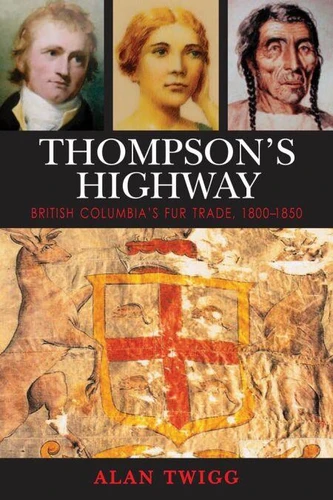
For his third volume about BC literary history, Alan Twigg
traces the writings of David Thompson, Alexander Mackenzie, Simon Fraser and
thirty of their peers, mainly Scotsmen, who founded and managed more than fifty
forts west of the Rockies prior to 1850. After the failure of Alexander
Mackenzie and Simon Fraser to find a navigable route to the Pacific Ocean, it
was the remarkable mapmaker, David Thompson, who was instrumental in creating
the "highway" for commerce that connected both sides of the North
American continent.
Thompson's exploration and mapping enabled George Simpson,
the "Little Emperor" of the Hudson's Bay Company, and James Douglas,
the founding father of the province, finally to bring viability to the
corporate fur trade on the so-called Western Slope.
For his third volume about BC literary history, Alan Twigg
traces the writings of David Thompson, Alexander Mackenzie, Simon Fraser and
thirty of their peers, mainly Scotsmen, who founded and managed more than fifty
forts west of the Rockies prior to 1850. After the failure of Alexander
Mackenzie and Simon Fraser to find a navigable route to the Pacific Ocean, it
was the remarkable mapmaker, David Thompson, who was instrumental in creating
the "highway" for commerce that connected both sides of the North
American continent.
Thompson's exploration and mapping enabled George Simpson,
the "Little Emperor" of the Hudson's Bay Company, and James Douglas,
the founding father of the province, finally to bring viability to the
corporate fur trade on the so-called Western Slope.


 , qui est-ce ?