Allen Downey is an Associate Professor of Computer Science at the Olin College of Engineering. He has taught computer science at Wellesley College, Colby College and U. C. Berkeley. He has a Ph. D. in Computer Science from U. C. Berkeley and Master's and Bachelor's degrees from MIT.
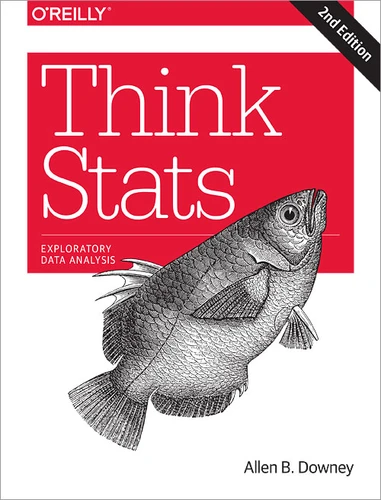
Think Stats
Par :Formats :
Disponible dans votre compte client Decitre ou Furet du Nord dès validation de votre commande. Le format Multi-format est :
- Pour les liseuses autres que Vivlio, vous devez utiliser le logiciel Adobe Digital Edition. Non compatible avec la lecture sur les liseuses Kindle, Remarkable et Sony
 , qui est-ce ?
Notre partenaire de plateforme de lecture numérique où vous retrouverez l'ensemble de vos ebooks gratuitement
Pour en savoir plus sur nos ebooks, consultez notre aide en ligne ici
C'est si simple ! Lisez votre ebook avec l'app Vivlio sur votre tablette, mobile ou ordinateur :

- Nombre de pages226
- FormatMulti-format
- ISBN978-1-4919-0732-0
- EAN9781491907320
- Date de parution16/10/2014
- Protection num.NC
- Infos supplémentairesMulti-format incluant PDF sans p...
- ÉditeurO'Reilly Media
Résumé
If you know how to program, you have the skills to turn data into knowledge, using tools of probability and statistics. This concise introduction shows you how to perform statistical analysis computationally, rather than mathematically, with programs written in Python.
By working with a single case study throughout this thoroughly revised book, you'll learn the entire process of exploratory data analysis-from collecting data and generating statistics to identifying patterns and testing hypotheses.
You'll explore distributions, rules of probability, visualization, and many other tools and concepts. New chapters on regression, time series analysis, survival analysis, and analytic methods will enrich your discoveries. - Develop an understanding of probability and statistics by writing and testing code - Run experiments to test statistical behavior, such as generating samples from several distributions - Use simulations to understand concepts that are hard to grasp mathematically - Import data from most sources with Python, rather than rely on data that's cleaned and formatted for statistics tools - Use statistical inference to answer questions about real-world data
You'll explore distributions, rules of probability, visualization, and many other tools and concepts. New chapters on regression, time series analysis, survival analysis, and analytic methods will enrich your discoveries. - Develop an understanding of probability and statistics by writing and testing code - Run experiments to test statistical behavior, such as generating samples from several distributions - Use simulations to understand concepts that are hard to grasp mathematically - Import data from most sources with Python, rather than rely on data that's cleaned and formatted for statistics tools - Use statistical inference to answer questions about real-world data