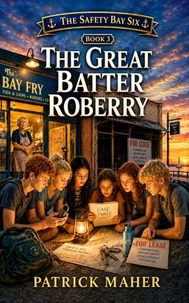
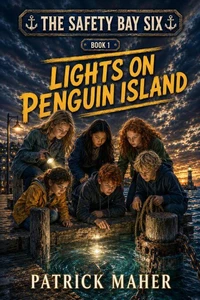
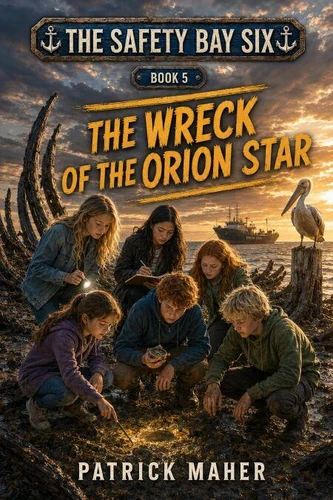
January brings the lowest tide in forty years to Safety Bay, Western Australia - and with it, rising from the sand off Becher Point, the black ribs of a crayboat that has not seen light since the winter of 1959. The Orion Star. And with the boat comes the story the town has been keeping in its tin: a missing bank payroll, a skipper who swam ashore through killing water and never explained himself, and sixty-five years of quiet suspicion that passed for certainty.
The Safety Bay Six - Rose, Annie, Kath, Vic, and Barry - have solved four cases on the foreshore they grew up on. This one has a different weight. The treasure hunters arrive with metal detectors and laminated maps. The newspapers print the legend as fact. And into it all comes Captain Wexford, silver-haired and unhurried, with a professional survey boat, the best mooring in the harbour, and a patience that turns out to span eleven years and three previous visits to the same stretch of Sound.
Mossy, the oldest man on the jetty, knew the Orion Star's skipper. He will not shake Wexford's hand. He will not say why. Annie's notebook fills with bearings and archive photographs. Vic intercepts survey signals. Kath reads the tidal tables with the focus of someone who knows the sea will not wait. And when the gang's investigation leads them to a State Records archive, a branch ledger in cotton gloves, and a set of handwritten initials beside a column of numbers that should not exist - the shape of the real crime comes clear.
Not treasure. Not a sunken payroll. Something far more careful, and far more damaging, than either. The Wreck of the Orion Star is a novel about the long patience of truth: how a wronged man chose the only game available to him, how sixty-five years of silence can be an act of love, and how five teenagers on bicycles - and one nine-year-old who is emphatically non-voting - can find what the official record missed.
It is also a novel about a tidal flat, a king low, a weather forecast that used the word 'possible', and the exact width of the margin between a good plan and a rescue boat in the rain.
January brings the lowest tide in forty years to Safety Bay, Western Australia - and with it, rising from the sand off Becher Point, the black ribs of a crayboat that has not seen light since the winter of 1959. The Orion Star. And with the boat comes the story the town has been keeping in its tin: a missing bank payroll, a skipper who swam ashore through killing water and never explained himself, and sixty-five years of quiet suspicion that passed for certainty.
The Safety Bay Six - Rose, Annie, Kath, Vic, and Barry - have solved four cases on the foreshore they grew up on. This one has a different weight. The treasure hunters arrive with metal detectors and laminated maps. The newspapers print the legend as fact. And into it all comes Captain Wexford, silver-haired and unhurried, with a professional survey boat, the best mooring in the harbour, and a patience that turns out to span eleven years and three previous visits to the same stretch of Sound.
Mossy, the oldest man on the jetty, knew the Orion Star's skipper. He will not shake Wexford's hand. He will not say why. Annie's notebook fills with bearings and archive photographs. Vic intercepts survey signals. Kath reads the tidal tables with the focus of someone who knows the sea will not wait. And when the gang's investigation leads them to a State Records archive, a branch ledger in cotton gloves, and a set of handwritten initials beside a column of numbers that should not exist - the shape of the real crime comes clear.
Not treasure. Not a sunken payroll. Something far more careful, and far more damaging, than either. The Wreck of the Orion Star is a novel about the long patience of truth: how a wronged man chose the only game available to him, how sixty-five years of silence can be an act of love, and how five teenagers on bicycles - and one nine-year-old who is emphatically non-voting - can find what the official record missed.
It is also a novel about a tidal flat, a king low, a weather forecast that used the word 'possible', and the exact width of the margin between a good plan and a rescue boat in the rain.

 , qui est-ce ?