
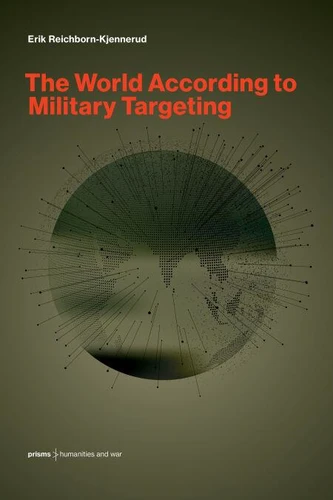
The World According to Military Targeting
Par :Formats :
Disponible dans votre compte client Decitre ou Furet du Nord dès validation de votre commande. Le format ePub protégé est :
- Compatible avec une lecture sur My Vivlio (smartphone, tablette, ordinateur)
- Compatible avec une lecture sur liseuses Vivlio
- Pour les liseuses autres que Vivlio, vous devez utiliser le logiciel Adobe Digital Edition. Non compatible avec la lecture sur les liseuses Kindle, Remarkable et Sony
- Non compatible avec un achat hors France métropolitaine
 , qui est-ce ?
Notre partenaire de plateforme de lecture numérique où vous retrouverez l'ensemble de vos ebooks gratuitement
Pour en savoir plus sur nos ebooks, consultez notre aide en ligne ici
C'est si simple ! Lisez votre ebook avec l'app Vivlio sur votre tablette, mobile ou ordinateur :

- Nombre de pages288
- FormatePub
- ISBN978-0-262-38316-5
- EAN9780262383165
- Date de parution27/05/2025
- Protection num.Adobe DRM
- Taille11 Mo
- Infos supplémentairesepub
- ÉditeurThe MIT Press
Résumé
A revealing account of the prevalence-and alarming ubiquity-of military targeting, and how it has become a self-propelling worldview driven by dominance, violence, and power. The World According to Military Targeting engages directly with our grave world condition, asking how we ended up in a "closed world" made for military targeting by military targeting. In this book, Erik Reichborn-Kjennerud explores how the operational logics and seductive forces of targeting produce a world in which the only ways to think about politics and security is through military supremacy, endless war, and global domination, with serious implications for social and political life.
Offering a critical investigation of military targeting through the lenses of its historical formation, current operations, and future implications, the author presents an innovative investigation into targeting's radical knowledge production, how it abstracts and brings into being new worlds, and the violence and destructive effects it generates. Through an interdisciplinary lens, the book draws attention to military doctrine and methodologies; statistical thought and practice; the mathematical and computational techniques of data production, processing, and modeling; and the so-called machine-learning algorithms and AI of today.
The resulting narrative provides novel insights into how imagining the world, producing the world, and operationalizing the world are always wrapped up in each other and profoundly embedded in sociotechnical systems.
Offering a critical investigation of military targeting through the lenses of its historical formation, current operations, and future implications, the author presents an innovative investigation into targeting's radical knowledge production, how it abstracts and brings into being new worlds, and the violence and destructive effects it generates. Through an interdisciplinary lens, the book draws attention to military doctrine and methodologies; statistical thought and practice; the mathematical and computational techniques of data production, processing, and modeling; and the so-called machine-learning algorithms and AI of today.
The resulting narrative provides novel insights into how imagining the world, producing the world, and operationalizing the world are always wrapped up in each other and profoundly embedded in sociotechnical systems.