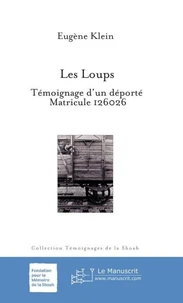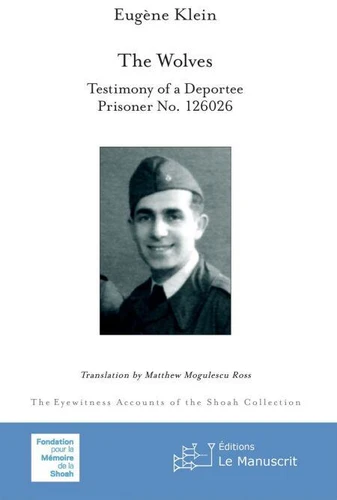
The Wolves. Testemony of a Deportee, Prisoner No. 126026
Par :Formats :
Disponible dans votre compte client Decitre ou Furet du Nord dès validation de votre commande. Le format ePub protégé est :
- Compatible avec une lecture sur My Vivlio (smartphone, tablette, ordinateur)
- Compatible avec une lecture sur liseuses Vivlio
- Pour les liseuses autres que Vivlio, vous devez utiliser le logiciel Adobe Digital Edition. Non compatible avec la lecture sur les liseuses Kindle, Remarkable et Sony
- Non compatible avec un achat hors France métropolitaine
 , qui est-ce ?
Notre partenaire de plateforme de lecture numérique où vous retrouverez l'ensemble de vos ebooks gratuitement
Pour en savoir plus sur nos ebooks, consultez notre aide en ligne ici
C'est si simple ! Lisez votre ebook avec l'app Vivlio sur votre tablette, mobile ou ordinateur :

- Nombre de pages136
- FormatePub
- ISBN978-2-304-04976-3
- EAN9782304049763
- Date de parution31/05/2022
- Protection num.Adobe & CARE
- Taille2 Mo
- Infos supplémentairesepub
- ÉditeurÉditions Le Manuscrit
Résumé
Eugène Klein led an extraordinary life, whose many facets he weaves together in this rich and unique account. Eugène grew up destitute in Hungary. He enlisted in the Austro-Hungarian Army during World War I and served in several theaters, including the Carpathian Front, where living conditions were harsh. He found happiness in France during the interwar period. He ran footraces, and his athletic talent allowed him to settle in France and start a family there.
As a Jew, Eugène and his family faced persecution by the Nazis: They were arrested in Paris on May 1, 1943 and deported to Auschwitz II-Birkenau in Poland. After surviving forced labor and a « death march », Eugène would be reunited with his wife, but his son would never return. This dignified account highlights the intelligence and integrity of a man who was both physically and mentally exceptional.
With the maturity of age, Eugène combines sincerity with restraint to deliver an account devoid of useless moralizing. Through a series of flashbacks, he demonstrates how his survival in the Nazi camps was certainly due to luck, but also to his prior life experiences, since he had already come face-to-face with humiliation, bitter cold, hunger and mass death, inhumane conditions... and wolves.
As a Jew, Eugène and his family faced persecution by the Nazis: They were arrested in Paris on May 1, 1943 and deported to Auschwitz II-Birkenau in Poland. After surviving forced labor and a « death march », Eugène would be reunited with his wife, but his son would never return. This dignified account highlights the intelligence and integrity of a man who was both physically and mentally exceptional.
With the maturity of age, Eugène combines sincerity with restraint to deliver an account devoid of useless moralizing. Through a series of flashbacks, he demonstrates how his survival in the Nazi camps was certainly due to luck, but also to his prior life experiences, since he had already come face-to-face with humiliation, bitter cold, hunger and mass death, inhumane conditions... and wolves.