
Nouveauté
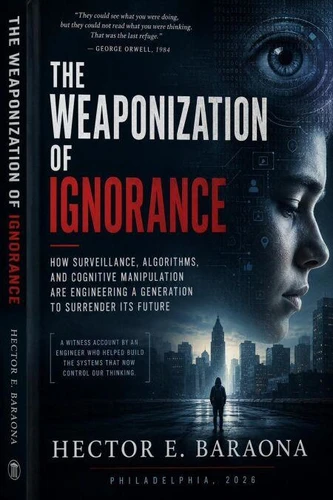
The Weaponization of Ignorance. ClearText Series, #1
Par :Formats :
Disponible dans votre compte client Decitre ou Furet du Nord dès validation de votre commande. Le format ePub est :
- Compatible avec une lecture sur My Vivlio (smartphone, tablette, ordinateur)
- Compatible avec une lecture sur liseuses Vivlio
- Pour les liseuses autres que Vivlio, vous devez utiliser le logiciel Adobe Digital Edition. Non compatible avec la lecture sur les liseuses Kindle, Remarkable et Sony
 , qui est-ce ?
Notre partenaire de plateforme de lecture numérique où vous retrouverez l'ensemble de vos ebooks gratuitement
Pour en savoir plus sur nos ebooks, consultez notre aide en ligne ici
C'est si simple ! Lisez votre ebook avec l'app Vivlio sur votre tablette, mobile ou ordinateur :

- FormatePub
- ISBN8235456556
- EAN9798235456556
- Date de parution21/07/2026
- Protection num.pas de protection
- Infos supplémentairesepub
- ÉditeurIoakim Ioakim
Résumé
For over four decades, Hector E. Baraona helped build the systems this book is about - artificial intelligence, autonomous robotics, the algorithmic infrastructure that now shapes how billions of people think, choose, and speak. The Weaponization of Ignorance is his account of what that work made him understand, and what it finally obligated him to say. This is not a technical manual. It is testimony - a first-person, evidence-grounded investigation into how surveillance, algorithmic design, and the quiet erosion of language have reshaped what a generation can think.
The book traces the mechanics in plain terms: how a phone in a pocket generates a data trail without a single choice being made; how content is not banned but simply starved of reach until it goes silent on its own; how the vocabulary available to a mind narrows, one small accommodation at a time, until certain thoughts become difficult to have at all. Drawing on documented research, historical parallel, and the author's own decades inside the rooms where these systems were designed, the book asks a harder question than most treatments of technology and society are willing to ask: not who is doing this to us, but how ordinary, reasonable, incremental choices - made by engineers, platforms, and users alike - added up to something none of them individually intended.
The Weaponization of Ignorance does not offer a villain. It offers an account, carefully witnessed, of a system built by people who could not fully see what they were building - and a case for what it takes to think clearly inside it.
The book traces the mechanics in plain terms: how a phone in a pocket generates a data trail without a single choice being made; how content is not banned but simply starved of reach until it goes silent on its own; how the vocabulary available to a mind narrows, one small accommodation at a time, until certain thoughts become difficult to have at all. Drawing on documented research, historical parallel, and the author's own decades inside the rooms where these systems were designed, the book asks a harder question than most treatments of technology and society are willing to ask: not who is doing this to us, but how ordinary, reasonable, incremental choices - made by engineers, platforms, and users alike - added up to something none of them individually intended.
The Weaponization of Ignorance does not offer a villain. It offers an account, carefully witnessed, of a system built by people who could not fully see what they were building - and a case for what it takes to think clearly inside it.