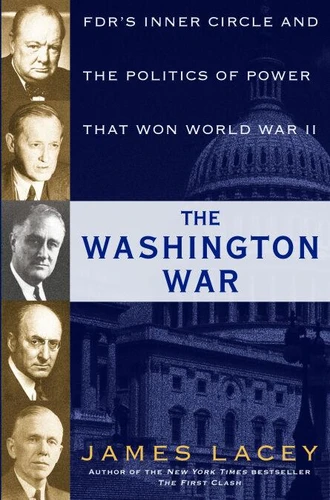
The Washington War. FDR's Inner Circle and the Politics of Power That Won World War II
Par :Formats :
Disponible dans votre compte client Decitre ou Furet du Nord dès validation de votre commande. Le format ePub protégé est :
- Compatible avec une lecture sur My Vivlio (smartphone, tablette, ordinateur)
- Compatible avec une lecture sur liseuses Vivlio
- Pour les liseuses autres que Vivlio, vous devez utiliser le logiciel Adobe Digital Edition. Non compatible avec la lecture sur les liseuses Kindle, Remarkable et Sony
- Non compatible avec un achat hors France métropolitaine
 , qui est-ce ?
Notre partenaire de plateforme de lecture numérique où vous retrouverez l'ensemble de vos ebooks gratuitement
Pour en savoir plus sur nos ebooks, consultez notre aide en ligne ici
C'est si simple ! Lisez votre ebook avec l'app Vivlio sur votre tablette, mobile ou ordinateur :

- Nombre de pages592
- FormatePub
- ISBN978-0-345-54759-0
- EAN9780345547590
- Date de parution28/05/2019
- Protection num.Adobe DRM
- Taille43 Mo
- Infos supplémentairesepub
- ÉditeurBANTAM
Résumé
A Team of Rivals for World War II-the inside story of how FDR and the towering personalities around him waged war in the corridors of Washington, D. C., to secure ultimate victory on the battlefields of Europe and the Pacific. The Washington War is the story of how the Second World War was fought and won in the capital's halls of power-and how the United States, which in December 1941 had a nominal army and a decimated naval fleet, was able in only thirty months to fling huge forces onto the European continent and shortly thereafter shatter Imperial Japan's Pacific strongholds.
Three quarters of a century after the overwhelming defeat of the totalitarian Axis forces, the terrifying, razor-thin calculus on which so many critical decisions turned has been forgotten-but had any of these debates gone the other way, the outcome of the war could have been far different: The army in August 1941, about to be disbanded, saved by a single vote. Production plans that would have delayed adequate war matériel for years after Pearl Harbor, circumvented by one uncompromising man's courage and drive.
The delicate ballet that precluded a separate peace between Stalin and Hitler. The almost-adopted strategy to stage D-Day at a fatally different time and place. It was all a breathtakingly close-run thing, again and again. Renowned historian James Lacey takes readers behind the scenes in the cabinet rooms, the Pentagon, the Oval Office, and Hyde Park, and at the pivotal conferences-Campobello Island, Casablanca, Tehran-as these disputes raged.
Here are colorful portraits of the great figures-and forgotten geniuses-of the day: New Dealers versus industrialists, political power brokers versus the generals, Churchill and the British high command versus the U. S. chiefs of staff, innovators versus entrenched bureaucrats .
Three quarters of a century after the overwhelming defeat of the totalitarian Axis forces, the terrifying, razor-thin calculus on which so many critical decisions turned has been forgotten-but had any of these debates gone the other way, the outcome of the war could have been far different: The army in August 1941, about to be disbanded, saved by a single vote. Production plans that would have delayed adequate war matériel for years after Pearl Harbor, circumvented by one uncompromising man's courage and drive.
The delicate ballet that precluded a separate peace between Stalin and Hitler. The almost-adopted strategy to stage D-Day at a fatally different time and place. It was all a breathtakingly close-run thing, again and again. Renowned historian James Lacey takes readers behind the scenes in the cabinet rooms, the Pentagon, the Oval Office, and Hyde Park, and at the pivotal conferences-Campobello Island, Casablanca, Tehran-as these disputes raged.
Here are colorful portraits of the great figures-and forgotten geniuses-of the day: New Dealers versus industrialists, political power brokers versus the generals, Churchill and the British high command versus the U. S. chiefs of staff, innovators versus entrenched bureaucrats .