
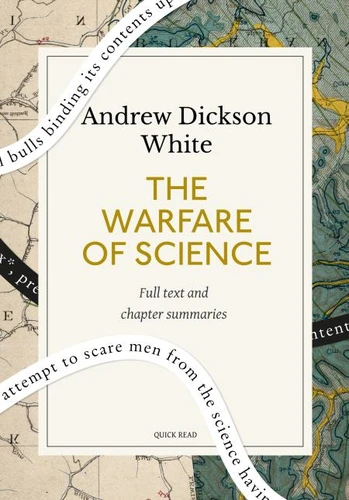
The Warfare of Science: A Quick Read edition
Par : ,Formats :
Disponible dans votre compte client Decitre ou Furet du Nord dès validation de votre commande. Le format Multi-format est :
- Pour les liseuses autres que Vivlio, vous devez utiliser le logiciel Adobe Digital Edition. Non compatible avec la lecture sur les liseuses Kindle, Remarkable et Sony
 , qui est-ce ?
Notre partenaire de plateforme de lecture numérique où vous retrouverez l'ensemble de vos ebooks gratuitement
Pour en savoir plus sur nos ebooks, consultez notre aide en ligne ici
C'est si simple ! Lisez votre ebook avec l'app Vivlio sur votre tablette, mobile ou ordinateur :

- FormatMulti-format
- ISBN978-2-38582-118-0
- EAN9782385821180
- Date de parution16/02/2024
- Protection num.pas de protection
- Infos supplémentairesMulti-Format
- ÉditeurQuick Read
Résumé
Discover a new way to read classics with Quick Read.
This Quick Read edition includes both the full text and a summary for each chapter.
- Reading time of the complete text: about 3 hours
- Reading time of the summarized text: 8 minutes
"A History of the Warfare of Science with Theology in Christendom" is a two-volume book published in 1896 by Andrew Dickson White. The book explores the conflict between science and religion throughout history.
It discusses various topics such as the literal interpretation of Genesis, the opposition faced by scientists like Copernicus and Galileo, the resistance against geological theories, the belief in demonic possession and witchcraft, and the condemnation of usury. The book also highlights the flawed arguments and poor scholarship of White, who popularized the idea of an adversarial relationship between science and religion.
However, recent scholarship has shown that the warfare thesis is neither useful nor accurate in describing the relationship between science and religion. Historians have rejected the myths propagated by White and other authors, such as the belief that people thought the world was flat before Columbus.
It discusses various topics such as the literal interpretation of Genesis, the opposition faced by scientists like Copernicus and Galileo, the resistance against geological theories, the belief in demonic possession and witchcraft, and the condemnation of usury. The book also highlights the flawed arguments and poor scholarship of White, who popularized the idea of an adversarial relationship between science and religion.
However, recent scholarship has shown that the warfare thesis is neither useful nor accurate in describing the relationship between science and religion. Historians have rejected the myths propagated by White and other authors, such as the belief that people thought the world was flat before Columbus.
A propos de Quick Read


4,99 €

4,99 €

4,99 €

4,99 €


4,99 €

4,99 €
4,99 €

4,99 €

4,99 €

4,99 €


4,99 €


4,99 €


4,99 €

4,99 €

4,99 €