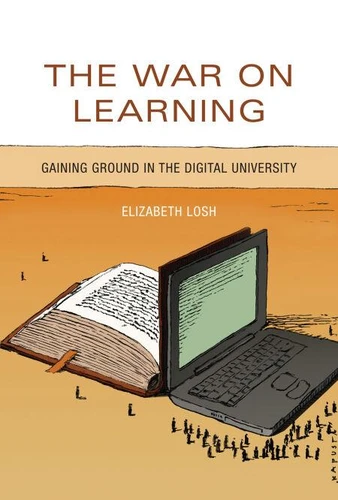
The War on Learning. Gaining Ground in the Digital University
Par :Formats :
Disponible dans votre compte client Decitre ou Furet du Nord dès validation de votre commande. Le format ePub protégé est :
- Compatible avec une lecture sur My Vivlio (smartphone, tablette, ordinateur)
- Compatible avec une lecture sur liseuses Vivlio
- Pour les liseuses autres que Vivlio, vous devez utiliser le logiciel Adobe Digital Edition. Non compatible avec la lecture sur les liseuses Kindle, Remarkable et Sony
- Non compatible avec un achat hors France métropolitaine
 , qui est-ce ?
Notre partenaire de plateforme de lecture numérique où vous retrouverez l'ensemble de vos ebooks gratuitement
Pour en savoir plus sur nos ebooks, consultez notre aide en ligne ici
C'est si simple ! Lisez votre ebook avec l'app Vivlio sur votre tablette, mobile ou ordinateur :

- Nombre de pages320
- FormatePub
- ISBN978-0-262-32326-0
- EAN9780262323260
- Date de parution02/05/2014
- Protection num.Adobe DRM
- Taille5 Mo
- Infos supplémentairesepub
- ÉditeurThe MIT Press
Résumé
An examination of technology-based education initiatives-from MOOCs to virtual worlds-that argues against treating education as a product rather than a process. Behind the lectern stands the professor, deploying course management systems, online quizzes, wireless clickers, PowerPoint slides, podcasts, and plagiarism-detection software. In the seats are the students, armed with smartphones, laptops, tablets, music players, and social networking.
Although these two forces seem poised to do battle with each other, they are really both taking part in a war on learning itself. In this book, Elizabeth Losh examines current efforts to "reform" higher education by applying technological solutions to problems in teaching and learning. She finds that many of these initiatives fail because they treat education as a product rather than a process. Highly touted schemes-video games for the classroom, for example, or the distribution of iPads-let students down because they promote consumption rather than intellectual development.
Losh analyzes recent trends in postsecondary education and the rhetoric around them, often drawing on first-person accounts. In an effort to identify educational technologies that might actually work, she looks at strategies including MOOCs (massive open online courses), the gamification of subject matter, remix pedagogy, video lectures (from Randy Pausch to "the Baked Professor"), and educational virtual worlds.
Finally, Losh outlines six basic principles of digital learning and describes several successful university-based initiatives. Her book will be essential reading for campus decision makers-and for anyone who cares about education and technology.
Although these two forces seem poised to do battle with each other, they are really both taking part in a war on learning itself. In this book, Elizabeth Losh examines current efforts to "reform" higher education by applying technological solutions to problems in teaching and learning. She finds that many of these initiatives fail because they treat education as a product rather than a process. Highly touted schemes-video games for the classroom, for example, or the distribution of iPads-let students down because they promote consumption rather than intellectual development.
Losh analyzes recent trends in postsecondary education and the rhetoric around them, often drawing on first-person accounts. In an effort to identify educational technologies that might actually work, she looks at strategies including MOOCs (massive open online courses), the gamification of subject matter, remix pedagogy, video lectures (from Randy Pausch to "the Baked Professor"), and educational virtual worlds.
Finally, Losh outlines six basic principles of digital learning and describes several successful university-based initiatives. Her book will be essential reading for campus decision makers-and for anyone who cares about education and technology.