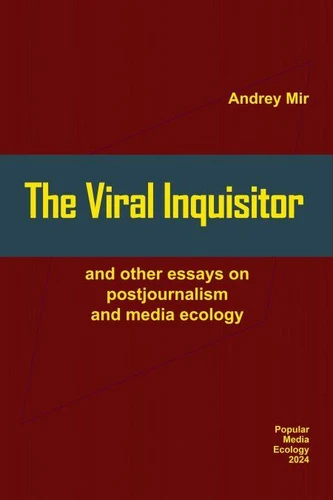
Media theorist Andrey Mir exposes the hidden media effects driving today's digital life, public debate, and political polarization. The Viral Inquisitor reveals how the very structure of digital media reshapes our minds, societies, and sense of truth. Martin Gurri (author of The Revolt of the Public) calls Mir "the most profound observer of media writing today"-and for good reason. In this wide-ranging collection of essays, Mir unpacks the biggest ideas behind the internet age: from the rise of postjournalism to the role of "lazy authorship" in shaping what we see, share, and believe.
He shows how the internet didn't just speed up communication-it transformed it, replacing traditional gatekeepers with a new, invisible force he calls "the Viral Editor": the collective engine that decides what spreads and what dies online. But that was just the beginning. In the book's title concept, the Viral Inquisitor, Mir tracks a darker evolution of the digital sphere: a system that doesn't just spread content but enforces emotional alignment.
Social media no longer simply surfaces what's popular-they deliver content that provokes, agitates, and pressures users to react in ways that reinforce group identity. In this new phase, algorithms and engagement loops don't just report what's viral-they demand responses, creating a dispersed digital tribunal where affirmation and outrage serve as proof of belonging. Drawing from media ecology, McLuhan's insights, and real-world events-from the Digital Rush of the 2010s to the backlash of Brexit and Trump-Mir explains how viral validation replaced traditional authority, how journalism abandoned objectivity for affirmation, and why digital culture rewards identity over merit.
He explores how "digital orality"-our hybrid form of online speech-reshapes everything from ethics to education, and why the collapse of media boundaries has left us in a state of constant reaction. Whether you're a journalist, student, tech skeptic, or curious reader trying to make sense of our information chaos, The Viral Inquisitor offers a fresh, essential framework for understanding the media world we now inhabit.
The writing is sharp, original, and accessible-even when the ideas are big. If you've ever wondered how everything got so loud, so fast, and so divided, this book is for you. Welcome to the postjournalistic era. Your newsfeed already knows what matters. This book explains how-and why.
Media theorist Andrey Mir exposes the hidden media effects driving today's digital life, public debate, and political polarization. The Viral Inquisitor reveals how the very structure of digital media reshapes our minds, societies, and sense of truth. Martin Gurri (author of The Revolt of the Public) calls Mir "the most profound observer of media writing today"-and for good reason. In this wide-ranging collection of essays, Mir unpacks the biggest ideas behind the internet age: from the rise of postjournalism to the role of "lazy authorship" in shaping what we see, share, and believe.
He shows how the internet didn't just speed up communication-it transformed it, replacing traditional gatekeepers with a new, invisible force he calls "the Viral Editor": the collective engine that decides what spreads and what dies online. But that was just the beginning. In the book's title concept, the Viral Inquisitor, Mir tracks a darker evolution of the digital sphere: a system that doesn't just spread content but enforces emotional alignment.
Social media no longer simply surfaces what's popular-they deliver content that provokes, agitates, and pressures users to react in ways that reinforce group identity. In this new phase, algorithms and engagement loops don't just report what's viral-they demand responses, creating a dispersed digital tribunal where affirmation and outrage serve as proof of belonging. Drawing from media ecology, McLuhan's insights, and real-world events-from the Digital Rush of the 2010s to the backlash of Brexit and Trump-Mir explains how viral validation replaced traditional authority, how journalism abandoned objectivity for affirmation, and why digital culture rewards identity over merit.
He explores how "digital orality"-our hybrid form of online speech-reshapes everything from ethics to education, and why the collapse of media boundaries has left us in a state of constant reaction. Whether you're a journalist, student, tech skeptic, or curious reader trying to make sense of our information chaos, The Viral Inquisitor offers a fresh, essential framework for understanding the media world we now inhabit.
The writing is sharp, original, and accessible-even when the ideas are big. If you've ever wondered how everything got so loud, so fast, and so divided, this book is for you. Welcome to the postjournalistic era. Your newsfeed already knows what matters. This book explains how-and why.

 , qui est-ce ?