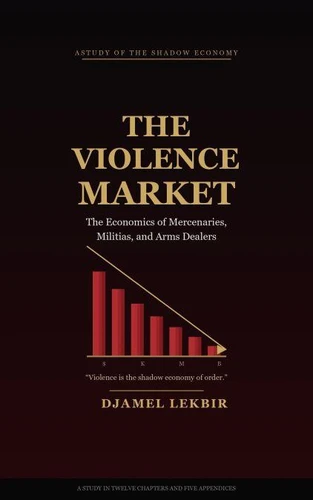
THE VIOLENCE MARKETThe Economics of Mercenaries, Militias, and Arms DealersWar has always been a business. This book is about who profits from it - and how. From the private armies of the ancient world to Wagner, Blackwater and the drone fleets of tomorrow, violence has never stopped being a market: with supply and demand, pricing and competition, profit margins and bankruptcy. Today that market is bigger and more sophisticated than ever - a global economy worth hundreds of billions of dollars, operating in the shadows of states.
The Violence Market is the first book to treat this world not as a series of shocking news stories, but as what it really is: an industry. Drawing on the economics of the firm, game theory and the political economy of conflict, it answers the questions that headlines never ask:. How does a militia finance itself? Gold, diamonds, oil, protection rackets, smuggling, hawala, cryptocurrencies - and why some models work better than others..
What does a mercenary really earn - from the Wagner commander to the foot soldier in a Syrian militia?. How do arms dealers like Viktor Bout build global networks, launder money, and survive sanctions?. Why do states use proxies - Russia and Wagner, Iran and Hezbollah, the UAE and its mercenaries in Yemen - and when do they discard them?. How do armed groups communicate, hide, and manage operations like a corporation?.
What happens when artificial intelligence, drones and cyberwarfare transform the cost of killing?With deep case studies, financing diagrams, data tables and projections to 2035, The Violence Market exposes the balance sheets of war: who wins, who loses, and why violence - like any market - obeys the laws of economics before it obeys the laws of men. A serious, rigorously researched and fiercely readable work of non-fiction for anyone who wants to understand the true engine of modern conflict - and the price the world pays for it."Violence is not the opposite of order.
It is the shadow economy of order." - Djamel Lekbir
THE VIOLENCE MARKETThe Economics of Mercenaries, Militias, and Arms DealersWar has always been a business. This book is about who profits from it - and how. From the private armies of the ancient world to Wagner, Blackwater and the drone fleets of tomorrow, violence has never stopped being a market: with supply and demand, pricing and competition, profit margins and bankruptcy. Today that market is bigger and more sophisticated than ever - a global economy worth hundreds of billions of dollars, operating in the shadows of states.
The Violence Market is the first book to treat this world not as a series of shocking news stories, but as what it really is: an industry. Drawing on the economics of the firm, game theory and the political economy of conflict, it answers the questions that headlines never ask:. How does a militia finance itself? Gold, diamonds, oil, protection rackets, smuggling, hawala, cryptocurrencies - and why some models work better than others..
What does a mercenary really earn - from the Wagner commander to the foot soldier in a Syrian militia?. How do arms dealers like Viktor Bout build global networks, launder money, and survive sanctions?. Why do states use proxies - Russia and Wagner, Iran and Hezbollah, the UAE and its mercenaries in Yemen - and when do they discard them?. How do armed groups communicate, hide, and manage operations like a corporation?.
What happens when artificial intelligence, drones and cyberwarfare transform the cost of killing?With deep case studies, financing diagrams, data tables and projections to 2035, The Violence Market exposes the balance sheets of war: who wins, who loses, and why violence - like any market - obeys the laws of economics before it obeys the laws of men. A serious, rigorously researched and fiercely readable work of non-fiction for anyone who wants to understand the true engine of modern conflict - and the price the world pays for it."Violence is not the opposite of order.
It is the shadow economy of order." - Djamel Lekbir


 , qui est-ce ?