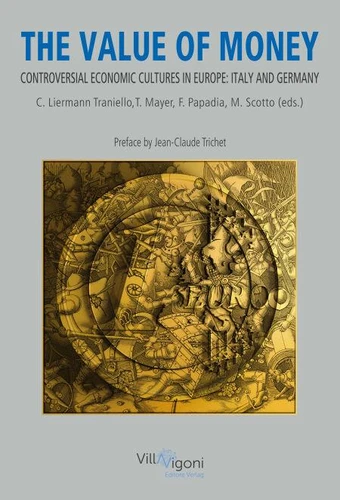
The Value of Money. Controversial Economic Cultures in Europe: Italy and Germany
Par : , , , ,Formats :
Disponible dans votre compte client Decitre ou Furet du Nord dès validation de votre commande. Le format ePub est :
- Compatible avec une lecture sur My Vivlio (smartphone, tablette, ordinateur)
- Compatible avec une lecture sur liseuses Vivlio
- Pour les liseuses autres que Vivlio, vous devez utiliser le logiciel Adobe Digital Edition. Non compatible avec la lecture sur les liseuses Kindle, Remarkable et Sony
 , qui est-ce ?
Notre partenaire de plateforme de lecture numérique où vous retrouverez l'ensemble de vos ebooks gratuitement
Pour en savoir plus sur nos ebooks, consultez notre aide en ligne ici
C'est si simple ! Lisez votre ebook avec l'app Vivlio sur votre tablette, mobile ou ordinateur :

- Nombre de pages248
- FormatePub
- ISBN978-3-98551-840-1
- EAN9783985518401
- Date de parution10/03/2021
- Protection num.Digital Watermarking
- Taille4 Mo
- Infos supplémentairesepub
- ÉditeurPhoemixx Classics Ebooks
Résumé
Thanks to the collaboration with renowned economists and policymakers, the publication compares Italian and German macro-economic cultures and performances. When the Bretton Woods system crumbled and currencies lost their direct link to the dollar and their indirect link to gold, these two countries embarked upon strongly different monetary policies. This divergence was reflected in the evolution of the exchange rates: the value of one D-Mark increased from 170 Italian lira under Bretton Woods to 990 Italian lira at the start of European Monetary Union: an astounding devaluation of about 85 per cent for the lira! Firstly, the volume describes the German and the Italian economic and, specifically, monetary models, with major attention paid to institutions such as Deutsche Bundesbank and Banca d'Italia, analysing their development in a diachronic perspective.
Secondly, these paradigms are contextualized within a broader European context, which is fundamental to reflect upon possible future scenarios. Das Buch versammelt renommierte Ökonomen und Politiker, hauptsächlich (aber nicht nur) aus Italien und Deutschland. Die Autoren vergleichen die makroökonomischen Kulturen und die Leistungsfähigkeit der beiden Länder. Seit dem Zusammenbruch des Bretton-Woods-Systems verfolgen beide Länder sehr unterschiedliche Geldpolitiken.
Die Divergenz spiegelte sich auch in der Entwicklung der Wechselkurse: Der Wert der D-Mark stieg von 170 italienischen Lire unter Bretton Woods-Bedingungen auf 990 italienische Lire zu Beginn der Europäischen Währungsunion - eine atemberaubende Abwertung der Lira um rund 85 Prozent! Der Sammelband beschreibt das deutsche und das italienische Wirtschafts- und insbesondere das Geldmodell. Institutionen wie die Bundesbank und die Banca d'Italia stehen im Zentrum.
Der historische Hintergrund wird ebenfalls ausgeleuchtet. In einem zweiten Schritt werden diese Modelle in einem breiteren europäischen Kontext analysiert, auch um mögliche künftige Szenarien aufzuzeigen. Mit Beiträgen von: Pierluigi Ciocca, Lorenzo Codogno, Fabio Colasanti, Federico Fubini, Daniel Gros, Otmar Issing, Harold James, Hans-Helmut Kotz, Ivo Maes, Klaus Masuch, Thomas Mayer, Stefano Micossi, Pier Carlo Padoan, Francesco Papadia, Lucio Pench, Tobias Piller, André Sapir, Gunther Schnabl, Ludger Schuhknecht, Sabine Seeger, Giulio Tremonti, Gertrude Tumpel-Gugerell.
Vorwort von Jean-Claude Trichet
Secondly, these paradigms are contextualized within a broader European context, which is fundamental to reflect upon possible future scenarios. Das Buch versammelt renommierte Ökonomen und Politiker, hauptsächlich (aber nicht nur) aus Italien und Deutschland. Die Autoren vergleichen die makroökonomischen Kulturen und die Leistungsfähigkeit der beiden Länder. Seit dem Zusammenbruch des Bretton-Woods-Systems verfolgen beide Länder sehr unterschiedliche Geldpolitiken.
Die Divergenz spiegelte sich auch in der Entwicklung der Wechselkurse: Der Wert der D-Mark stieg von 170 italienischen Lire unter Bretton Woods-Bedingungen auf 990 italienische Lire zu Beginn der Europäischen Währungsunion - eine atemberaubende Abwertung der Lira um rund 85 Prozent! Der Sammelband beschreibt das deutsche und das italienische Wirtschafts- und insbesondere das Geldmodell. Institutionen wie die Bundesbank und die Banca d'Italia stehen im Zentrum.
Der historische Hintergrund wird ebenfalls ausgeleuchtet. In einem zweiten Schritt werden diese Modelle in einem breiteren europäischen Kontext analysiert, auch um mögliche künftige Szenarien aufzuzeigen. Mit Beiträgen von: Pierluigi Ciocca, Lorenzo Codogno, Fabio Colasanti, Federico Fubini, Daniel Gros, Otmar Issing, Harold James, Hans-Helmut Kotz, Ivo Maes, Klaus Masuch, Thomas Mayer, Stefano Micossi, Pier Carlo Padoan, Francesco Papadia, Lucio Pench, Tobias Piller, André Sapir, Gunther Schnabl, Ludger Schuhknecht, Sabine Seeger, Giulio Tremonti, Gertrude Tumpel-Gugerell.
Vorwort von Jean-Claude Trichet