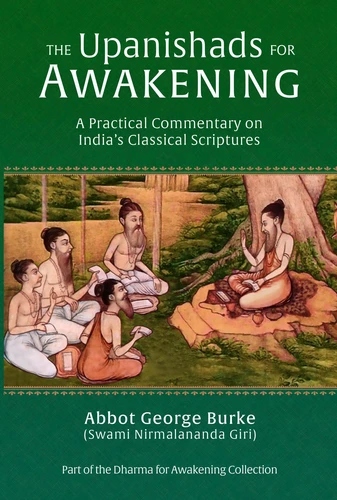
The Upanishads for Awakening: A Practical Commentary on India’s Classical Scriptures
Par :Formats :
Disponible dans votre compte client Decitre ou Furet du Nord dès validation de votre commande. Le format ePub est :
- Compatible avec une lecture sur My Vivlio (smartphone, tablette, ordinateur)
- Compatible avec une lecture sur liseuses Vivlio
- Pour les liseuses autres que Vivlio, vous devez utiliser le logiciel Adobe Digital Edition. Non compatible avec la lecture sur les liseuses Kindle, Remarkable et Sony
 , qui est-ce ?
Notre partenaire de plateforme de lecture numérique où vous retrouverez l'ensemble de vos ebooks gratuitement
Pour en savoir plus sur nos ebooks, consultez notre aide en ligne ici
C'est si simple ! Lisez votre ebook avec l'app Vivlio sur votre tablette, mobile ou ordinateur :

- FormatePub
- ISBN978-1-7331643-0-6
- EAN9781733164306
- Date de parution15/07/2019
- Protection num.pas de protection
- Infos supplémentairesepub
- ÉditeurAbbot George Burke (Swami Nirm
Résumé
With penetrating insight, Abbot George Burke illumines the Upanishads' practical value for spiritual seekers. With a unique perspective from a lifetime of study and practice of both Eastern and Western spirituality, he presents the treasures of the Upanishads in an easily intelligible fashion. The sacred scriptures of India are vast. Yet they are only different ways of seeing the same thing, the One Thing which makes them both valid and ultimately harmonious.
That unifying subject is Brahman: God the Absolute, beyond and besides whom there is no "other" whatsoever. The thirteen major Upanishads are the fountainhead of all expositions of Brahman. The word "upanishad" itself comes from the root word upasana, which means to draw or sit near, and is usually considered to mean that which was heard when the student sat near the teacher to learn the eternal truths.
We do not know who wrote the Upanishads. This has a distinct advantage in that the image of a historical, finite personality does not intervene to obscure the revelation handed on to spiritual aspirants. The authority of the Upanishads rests not upon those who wrote them, but upon the demonstrable truths they express. They are as self-sufficient and self-evident as the multiplication tables or the Table of Elements.
They are simply the complete and unobscured truth. And realization of that Truth alone matters.
That unifying subject is Brahman: God the Absolute, beyond and besides whom there is no "other" whatsoever. The thirteen major Upanishads are the fountainhead of all expositions of Brahman. The word "upanishad" itself comes from the root word upasana, which means to draw or sit near, and is usually considered to mean that which was heard when the student sat near the teacher to learn the eternal truths.
We do not know who wrote the Upanishads. This has a distinct advantage in that the image of a historical, finite personality does not intervene to obscure the revelation handed on to spiritual aspirants. The authority of the Upanishads rests not upon those who wrote them, but upon the demonstrable truths they express. They are as self-sufficient and self-evident as the multiplication tables or the Table of Elements.
They are simply the complete and unobscured truth. And realization of that Truth alone matters.