SOLDES
Jusqu'à -70% sur une sélection d'articles*

Nouveauté
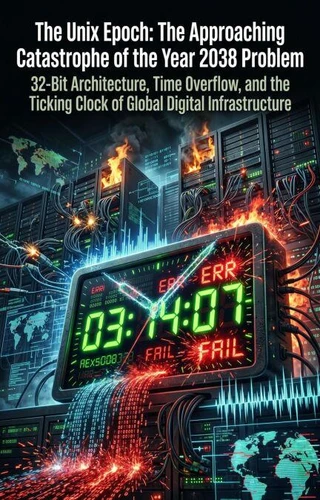
The Unix Epoch: The Approaching Catastrophe of the Year 2038 Problem. 32-Bit Architecture, Time Overflow, and the Ticking Clock of Global Digital Infrastructure
Par :Formats :
Disponible dans votre compte client Decitre ou Furet du Nord dès validation de votre commande. Le format ePub est :
- Compatible avec une lecture sur My Vivlio (smartphone, tablette, ordinateur)
- Compatible avec une lecture sur liseuses Vivlio
- Pour les liseuses autres que Vivlio, vous devez utiliser le logiciel Adobe Digital Edition. Non compatible avec la lecture sur les liseuses Kindle, Remarkable et Sony
 , qui est-ce ?
Notre partenaire de plateforme de lecture numérique où vous retrouverez l'ensemble de vos ebooks gratuitement
Pour en savoir plus sur nos ebooks, consultez notre aide en ligne ici
C'est si simple ! Lisez votre ebook avec l'app Vivlio sur votre tablette, mobile ou ordinateur :

- Nombre de pages206
- FormatePub
- ISBN978-3-565-46674-0
- EAN9783565466740
- Date de parution29/05/2026
- Protection num.pas de protection
- Taille954 Ko
- Infos supplémentairesepub
- ÉditeurEmphaloz Publishing House
Résumé
You have heard of the Y2K bug, but are you aware of the vastly more dangerous, mathematically inevitable software apocalypse currently ticking away deep inside the global digital infrastructure? It is called the Year 2038 Problem, and it threatens to instantly crash databases, flight control systems, and financial networks worldwide.
The foundational timekeeping system for most of the world's computer networks is Unix time, which counts the number of seconds that have elapsed since January 1, 1970.
Billions of embedded systems store this number as a signed 32-bit integer. The terrifying mathematical reality is that a 32-bit integer can only hold a maximum value of 2, 147, 483, 647. On January 19, 2038, at exactly 03:14:07 UTC, this maximum capacity will be reached. The integer will overflow and instantly wrap around to a massive negative number, tricking global computer systems into believing the current year is 1901, triggering immediate logic failures and catastrophic system crashes. This profound computer science exploration dissects the immense logistical nightmare of upgrading the world.
It explains the mechanics of integer overflow, the monumental difficulty of patching embedded microcontrollers in satellites and pacemakers, and the race to transition to a 64-bit architecture. The clock is mathematically running out. The Year 2038 Problem is a chilling reminder of how deeply modern society is chained to the arbitrary architectural limits of 1970s programming.
Billions of embedded systems store this number as a signed 32-bit integer. The terrifying mathematical reality is that a 32-bit integer can only hold a maximum value of 2, 147, 483, 647. On January 19, 2038, at exactly 03:14:07 UTC, this maximum capacity will be reached. The integer will overflow and instantly wrap around to a massive negative number, tricking global computer systems into believing the current year is 1901, triggering immediate logic failures and catastrophic system crashes. This profound computer science exploration dissects the immense logistical nightmare of upgrading the world.
It explains the mechanics of integer overflow, the monumental difficulty of patching embedded microcontrollers in satellites and pacemakers, and the race to transition to a 64-bit architecture. The clock is mathematically running out. The Year 2038 Problem is a chilling reminder of how deeply modern society is chained to the arbitrary architectural limits of 1970s programming.