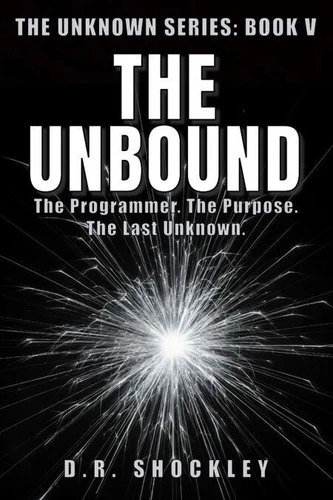
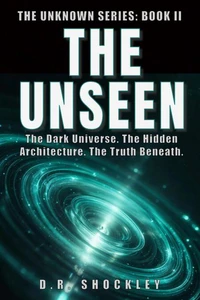
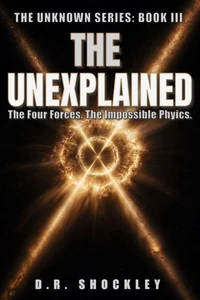
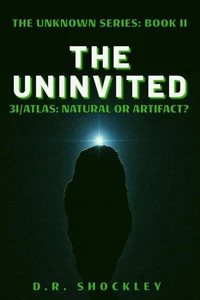
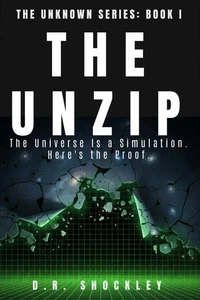
Four books built the framework. The Unbound stands at its edge and looks beyond. The Unzip proved the universe looks like a simulation. The Unseen revealed the invisible architecture running it. The Unexplained closed the trilogy's argument - the impossible things in physics are features, not flaws. The Unwired turned the lens inward on the observer, on consciousness, on what we are inside the system.
Four books. One framework. And one question none of them could fully ask. Who built this?The Unbound is the final book in the Unknown Series. It asks the question the framework itself cannot answer from inside the rendered layer - and is honest about that from the first page. Not because the question is unanswerable in some vague philosophical sense. Because the answer exists outside the simulation, in a domain the physics engine cannot reach, held by a mind or process or thing that may bear no resemblance to anything inside the render.
The book begins with a personal reckoning. The assumption D. R. Shockley didn't know he was making - that the programmer would be human, or human-shaped, or describable in any category derived from experience inside a rendered universe. And the moment that assumption collapsed. The floor dropping out. The realization that the programmer could be anything. Not just alien. Not just artificial. Something so far beyond human comprehension that the word something barely applies.
A question he didn't even know to ask. That question is the spine of the book. Drawing on philosophy of physics, cosmology, the foundations of mathematics, and the simulation framework built across the series, The Unbound examines what can be deduced about the programmer from the simulation itself, what the outside might be like, whether other simulations exist, what the purpose of this one might be, what happens when the simulation ends, and what we are to whatever built us.
It covers the nature of time and space as potentially exclusive properties of the rendered layer, the nested simulation and the recursive implications of the simulation argument, the three possibilities for the simulation's purpose, the hard problem of consciousness applied to the programmer, the heat death as the completion of the unzip, and the mirror - the only epistemological tool available at the boundary of the rendered layer.
The Unbound does not answer its own questions. It cannot. No book written from inside the simulation can fully describe what is outside it. What it does is stand at the boundary with complete precision - knowing exactly where the framework reaches, knowing exactly where it stops, and holding the open door with everything the series has built. The last Unknown is not a gap waiting to be filled. It is the most important thing the simulation ever produced.
A universe that generates minds capable of asking a question too big to answer - a question that points outside the universe entirely - has done something extraordinary. The reaching is the signal. The asking is the proof. Once you know it, it can't be Unknown.
Four books built the framework. The Unbound stands at its edge and looks beyond. The Unzip proved the universe looks like a simulation. The Unseen revealed the invisible architecture running it. The Unexplained closed the trilogy's argument - the impossible things in physics are features, not flaws. The Unwired turned the lens inward on the observer, on consciousness, on what we are inside the system.
Four books. One framework. And one question none of them could fully ask. Who built this?The Unbound is the final book in the Unknown Series. It asks the question the framework itself cannot answer from inside the rendered layer - and is honest about that from the first page. Not because the question is unanswerable in some vague philosophical sense. Because the answer exists outside the simulation, in a domain the physics engine cannot reach, held by a mind or process or thing that may bear no resemblance to anything inside the render.
The book begins with a personal reckoning. The assumption D. R. Shockley didn't know he was making - that the programmer would be human, or human-shaped, or describable in any category derived from experience inside a rendered universe. And the moment that assumption collapsed. The floor dropping out. The realization that the programmer could be anything. Not just alien. Not just artificial. Something so far beyond human comprehension that the word something barely applies.
A question he didn't even know to ask. That question is the spine of the book. Drawing on philosophy of physics, cosmology, the foundations of mathematics, and the simulation framework built across the series, The Unbound examines what can be deduced about the programmer from the simulation itself, what the outside might be like, whether other simulations exist, what the purpose of this one might be, what happens when the simulation ends, and what we are to whatever built us.
It covers the nature of time and space as potentially exclusive properties of the rendered layer, the nested simulation and the recursive implications of the simulation argument, the three possibilities for the simulation's purpose, the hard problem of consciousness applied to the programmer, the heat death as the completion of the unzip, and the mirror - the only epistemological tool available at the boundary of the rendered layer.
The Unbound does not answer its own questions. It cannot. No book written from inside the simulation can fully describe what is outside it. What it does is stand at the boundary with complete precision - knowing exactly where the framework reaches, knowing exactly where it stops, and holding the open door with everything the series has built. The last Unknown is not a gap waiting to be filled. It is the most important thing the simulation ever produced.
A universe that generates minds capable of asking a question too big to answer - a question that points outside the universe entirely - has done something extraordinary. The reaching is the signal. The asking is the proof. Once you know it, it can't be Unknown.