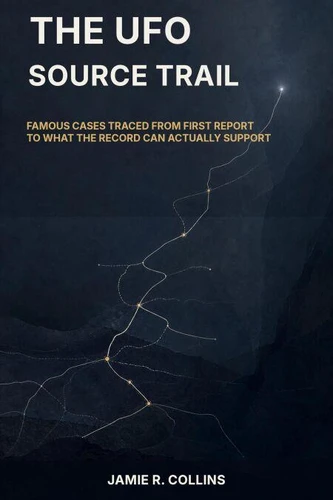
An official document can be genuine while the claim inside it remains unverified. A witness can be sincere while memory changes. A video can be authentic while its apparent speed is misleading. A physical trace can be real while its cause remains unknown. Those distinctions are the heart of The UFO Source Trail. Jamie R. Collins follows nine celebrated UFO case families from their earliest accessible reports through government files, archive records, witness accounts, later books and broadcasts, technical analyses, and unresolved gaps.
Roswell reveals how an official reversal and decades of retelling can harden into legend. MJ-12 tests whether archive custody can authenticate a disputed document. The Hill and Rendlesham cases show how memories and narratives expand. Tehran and Nimitz expose the difference between reports about sensors and publicly inspectable data. GoFast demonstrates how geometry can change the meaning of an authentic image.
Falcon Lake and Trans-en-Provence bring physical effects, custody, sampling, and causation into view. The book takes witnesses seriously without asking the evidence to carry more than it can. It gives the strongest supported extraordinary reading and the strongest competing account, identifies the missing evidence that would change the finding, and labels uncertainty precisely. For readers interested in UFOs, UAP, government records, media literacy, aviation, modern folklore, and the craft of investigation, The UFO Source Trail offers a durable way to read the next extraordinary headline.
An official document can be genuine while the claim inside it remains unverified. A witness can be sincere while memory changes. A video can be authentic while its apparent speed is misleading. A physical trace can be real while its cause remains unknown. Those distinctions are the heart of The UFO Source Trail. Jamie R. Collins follows nine celebrated UFO case families from their earliest accessible reports through government files, archive records, witness accounts, later books and broadcasts, technical analyses, and unresolved gaps.
Roswell reveals how an official reversal and decades of retelling can harden into legend. MJ-12 tests whether archive custody can authenticate a disputed document. The Hill and Rendlesham cases show how memories and narratives expand. Tehran and Nimitz expose the difference between reports about sensors and publicly inspectable data. GoFast demonstrates how geometry can change the meaning of an authentic image.
Falcon Lake and Trans-en-Provence bring physical effects, custody, sampling, and causation into view. The book takes witnesses seriously without asking the evidence to carry more than it can. It gives the strongest supported extraordinary reading and the strongest competing account, identifies the missing evidence that would change the finding, and labels uncertainty precisely. For readers interested in UFOs, UAP, government records, media literacy, aviation, modern folklore, and the craft of investigation, The UFO Source Trail offers a durable way to read the next extraordinary headline.

 , qui est-ce ?