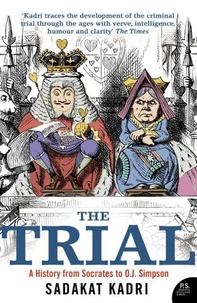
For as long as accuser and accused have faced each other in public, criminal trials have been establishing far more than who did what to whom-and in this fascinating book, Sadakat Kadri surveys four thousand years of courtroom drama. A brilliantly engaging writer, Kadri journeys from the silence of ancient Egypt's Hall of the Dead to the clamor of twenty-first-century Hollywood to show how emotion and fear have inspired Western notions of justice-and the extent to which they still riddle its trials today.
He explains, for example, how the jury emerged in medieval England from trials by fire and water, in which validations of vengeance were presumed to be divinely supervised, and how delusions identical to those that once sent witches to the stake were revived as accusations of Satanic child abuse during the 1980s. Lifting the lid on a particularly bizarre niche of legal history, Kadri tells how European lawyers once prosecuted animals, objects, and corpses-and argues that the same instinctive urge to punish is still apparent when a child or mentally ill defendant is accused of sufficiently heinous crimes.
But Kadri's history is about aspiration as well as ignorance. He shows how principles such as the right to silence and the right to confront witnesses, hallmarks of due process guaranteed by the U. S. Constitution, were derived from the Bible by twelfth-century monks. He tells of show trials from Tudor England to Stalin's Soviet Union, but contends that "no-trials, " in Guantánamo Bay and elsewhere, are just as repugnant to Western traditions of justice and fairness.
With governments everywhere eroding legal protections in the name of an indefinite war on terror, Kadri's analysis could hardly be timelier. At once encyclopedic and entertaining, comprehensive and colorful, The Trial rewards curiosity and an appreciation of the absurd but tackles as well questions that are profound. Who has the right to judge, and why? What did past civilizations hope to achieve through scapegoats and sacrifices-and to what extent are defendants still made to bear the sins of society at large? Kadri addresses such themes through scores of meticulously researched stories, all told with the verve and wit that won him one of Britain's most prestigious travel-writing awards-and in doing so, he has created a masterpiece of popular history.
For as long as accuser and accused have faced each other in public, criminal trials have been establishing far more than who did what to whom-and in this fascinating book, Sadakat Kadri surveys four thousand years of courtroom drama. A brilliantly engaging writer, Kadri journeys from the silence of ancient Egypt's Hall of the Dead to the clamor of twenty-first-century Hollywood to show how emotion and fear have inspired Western notions of justice-and the extent to which they still riddle its trials today.
He explains, for example, how the jury emerged in medieval England from trials by fire and water, in which validations of vengeance were presumed to be divinely supervised, and how delusions identical to those that once sent witches to the stake were revived as accusations of Satanic child abuse during the 1980s. Lifting the lid on a particularly bizarre niche of legal history, Kadri tells how European lawyers once prosecuted animals, objects, and corpses-and argues that the same instinctive urge to punish is still apparent when a child or mentally ill defendant is accused of sufficiently heinous crimes.
But Kadri's history is about aspiration as well as ignorance. He shows how principles such as the right to silence and the right to confront witnesses, hallmarks of due process guaranteed by the U. S. Constitution, were derived from the Bible by twelfth-century monks. He tells of show trials from Tudor England to Stalin's Soviet Union, but contends that "no-trials, " in Guantánamo Bay and elsewhere, are just as repugnant to Western traditions of justice and fairness.
With governments everywhere eroding legal protections in the name of an indefinite war on terror, Kadri's analysis could hardly be timelier. At once encyclopedic and entertaining, comprehensive and colorful, The Trial rewards curiosity and an appreciation of the absurd but tackles as well questions that are profound. Who has the right to judge, and why? What did past civilizations hope to achieve through scapegoats and sacrifices-and to what extent are defendants still made to bear the sins of society at large? Kadri addresses such themes through scores of meticulously researched stories, all told with the verve and wit that won him one of Britain's most prestigious travel-writing awards-and in doing so, he has created a masterpiece of popular history.

 , qui est-ce ?